Spanish
  English
  Russian
  Korean
  Indonesian
  Thai
Thai 

There are great differences between food products in terms of their size, shape, moisture content, viscosity, and flowability; therefore, packaging systems are not identical for all of them. Food packaging equipment can be adapted to process a variety of food products, including rice and grains, sauces, snacks, meat, seafood, and frozen foods. In other words, the process of packaging will depend on the nature of the food product being processed.
When selecting packaging machinery, manufacturers should consider factors such as speed of processing as well as the weight, particle size, moisture, temperature, viscosity, package dimensions, and required shelf life of the product being processed. There might be cases whereby food packaging machines will include several processes such as weighing, filling, sealing, coding, and inspections in an effort to enhance consistency in production.
1. What Types of Food Can Be Packaged by Food Packaging Equipment?
Dry and Granular Foods
Among the most commonly packaged products using food packaging equipment are those dry and granular in nature. Such products include rice, beans, grains, nuts, seeds, pasta, dried fruits, pet foods, and other similar products. These products have different particle sizes and flow rates, and therefore the selection of a dosing system will depend on the product.
For products with relatively uniform particles, weighing systems can provide consistent portion control. Multihead weighers are often employed when different quantities have to be quickly weighed before being put into bags or pouches. The weight of the packages can vary between retail sizes of 50 – 500 grams and several kilograms in commercial packs.
Snacks and Confectionery
When packing snack and confectionery goods, manufacturers should pay extra attention. This is because most of them are very light, have an irregular shape, or can easily get broken. Potato chips, biscuits, corn, cookies, candy, chocolates, and so on can be packed in various containers. The package formats include bags, pouches, trays, and others. The packaging should provide enough protection while ensuring uniform portion sizes and good sealing.
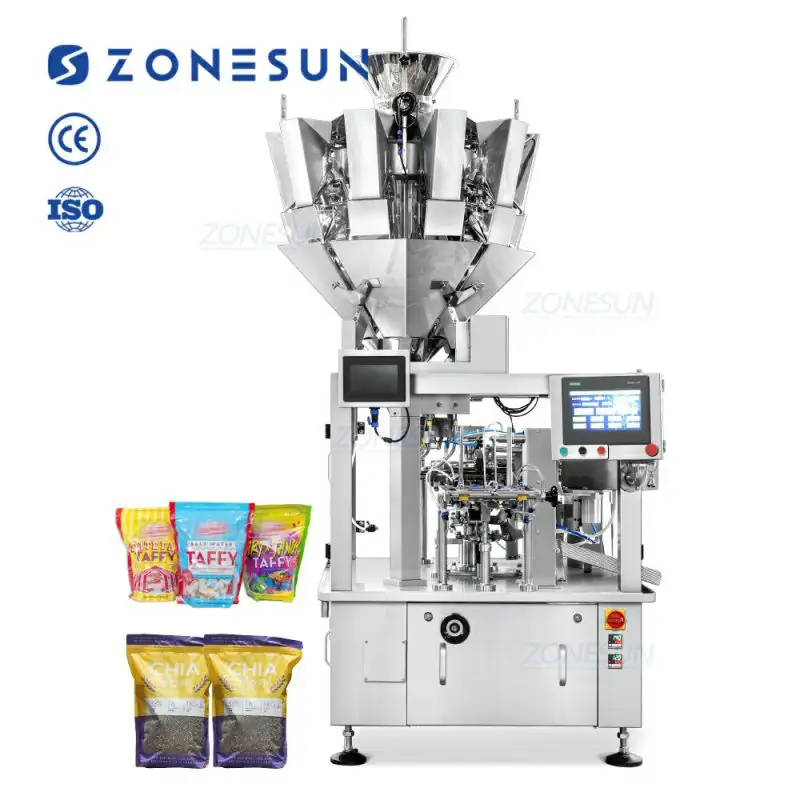
For manufacturers packaging snacks in premade pouches, ZONESUN PACKAGING’s Rotary Premade Pouch Packing Machine is a practical option. It automates pouch feeding, opening, filling, and sealing, while a multi-head weigher helps control the filling quantity. Key features include:
- Working speed: About 10–60 bags/min
- Measuring system: Multi-head weigher
- Package types: Flat, stand-up, and zipper pouches
- Productos adecuados: Mixed nuts, dried fruits, pet food, beef jerky, and crisps
Powdered Foods
Powdered products are very common in daily life. Flour, milk powder, protein powder, coffee, spices, seasoning blends, and instant food ingredients are all in powder form. When filling powders, it may produce airborne dust. And they will create bridges inside hoppers or become compacted during handling. Food Packaging Equipment for powders therefore needs a dosing system that can maintain stable material flow and consistent filling quantities.
Auger fillers are often suitable for powders because the screw mechanism can control a defined quantity of material. Powdered products might use various packaging formats. They can be packed in sachets, stick packs, pouches, or larger bags. Sealing performance is also important because fine powder around the seal area can affect package integrity.
Liquid and Semi-Liquid Foods
Liquid and semi-liquid foods should be packaged in another way because they pour rather than form separate units. Examples include cooking oil, juices, milk, sauces, ketchup, honey, jams, salad dressings, etc.
Food Packaging Equipment for the last type of products usually employs pumps or volumetric filling. In the case with low-viscous liquids, the filling has to be done at a high speed, whereas more viscous requires special pumps ensuring stable flow. The volume of the fill may vary from small sachets of 10 – 50 millilitres to large bottles of 500 ml, 1 liter, or even more.
Meat and Seafood Products
The Food Packaging Equipment utilized for this type of food should have systems dealing with moisture content, exposure to oxygen, leakage, hygiene, and temperature conditions. This category could consist of beef, pork, poultry, fish fillets, shrimp, squid, and seafood portions.
Vacuum packaging and modified atmosphere packaging (MAP) techniques are the packaging techniques that are commonly applied to such products. Effective packaging will assist in preserving product quality during storage and transportation. However, packaging alone cannot do much unless there is proper temperature control.
Frozen and Ready-to-Eat Foods
Another category of products requiring special food packaging equipment is frozen foods and ready-to-eat foods. When packing frozen vegetables, frozen fruits, French fries, frozen seafood, frozen meat, pizza, and ready-to-eat meals, manufacturers need special consideration. This is because the materials and seals must be able to survive in low-temperature conditions.
Ready-to-eat meals normally use tray sealing, pouch packaging, and flow wrapping. Frozen foods will require special machines that will seal without damaging the product, causing condensation of the product, or causing problems in sealing.
2. What Food Packaging Equipment Is Used for Different Foods?
The Food Packaging Equipment that is needed largely depends on the nature of the product. The product can be solid, granular, powdered, liquid, viscous, fresh, or frozen. When making a proper selection of packaging equipment, there are some important factors to consider. They include packaging size, desired production rate, filling precision, sealing process, and extent of automation required.
Weighing and Filling Equipment for Solid Foods
Solids and granular products are usually weighed using the weighing method and then filled into sacks or pouches. A multihead weighing machine divides the product into several parts and weighs a selected number to reach the desired weight. In one case, a company manufacturing 500 grams bags of snacks would focus on the accuracy of weighing and high production, whereas another company dealing with 5 kg or 10 kg packs would focus more on the capacity of the hoppers. Important factors include:
- Target weight: From small retail portions to multi-kilogram packs
- Product characteristics: Particle size, shape, density, and fragility
- Salida: Required bags or packages per minute
- Package format: Pouches, bags, trays, or containers
Filling and Sealing Equipment for Liquid Foods
A filling process has to be controlled for liquid and semi-liquid products to avoid underfilling, overfilling, splashing, and dripping. The filling design depends on the viscosity of the products. For low-viscosity liquids, high-speed pumps will be suitable. On the other hand, viscous products like jam and sauce will need filling machines capable of ensuring smooth flow of materials.
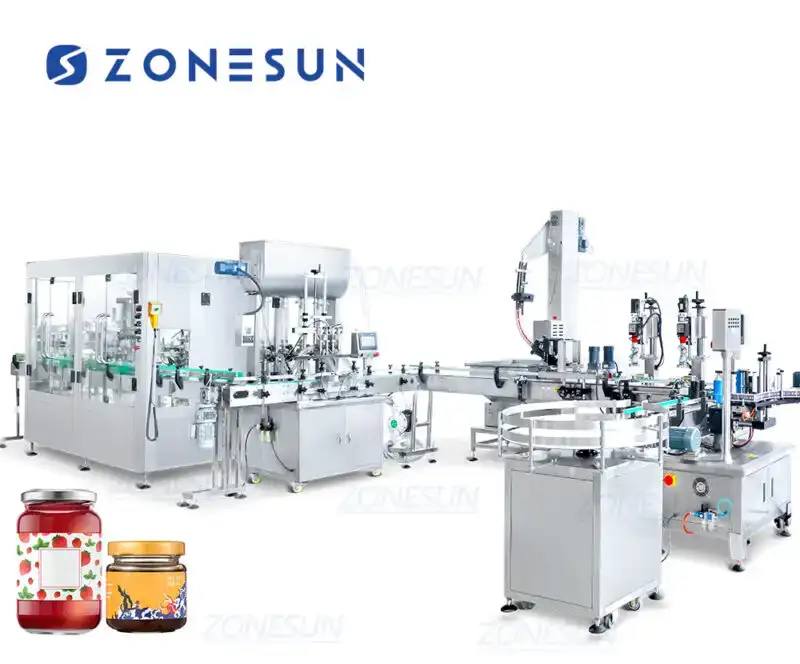
For food processing plants packing thick sauces and fruit jams, a good choice would be the ZONESUN PACKAGING Fully Automatic Strawberry Jam Pasta Sauce Bottle Filling Line. It is a complete packaging line combining a piston pump and four pneumatic nozzles for viscous products, as well as incorporating bottle rinsing, filling, capping, and labeling into one line. Some features include:
- Rango de llenado:5–5,000 ml
- Precisión de llenado:≤±1%
- Working speed: About 20–50 bottles/min
- Sistema de llenado: Piston pump with four pneumatic nozzles
- Productos adecuados: Fruit jam, pasta sauce, sriracha sauce, chili paste, and peanut butter
Vacuum Packaging Equipment for Meat and Seafood
The vacuum packing machine removes air from the package before sealing the package. Vacuuming helps reduce exposure to oxygen and can protect some kinds of meat and seafood during their refrigeration and freezing period. Vacuum and MAP technologies are commonly used in protein packaging applications where freshness and package integrity are important.
The Food Packaging Equipment for Meat & Seafood must be able to work well in wet environments and undergo regular cleaning. Some important factors in Food Packaging Equipment include stainless steel, easy cleaning, seal efficiency, and film compatibility for commercial meat and seafood businesses.
Filling Equipment for Powdered Foods
Packaging powdered foods requires an accurate dosing system to ensure consistent fill quantities. The filling process should prevent excess dust and avoid powder affecting bottle sealing.
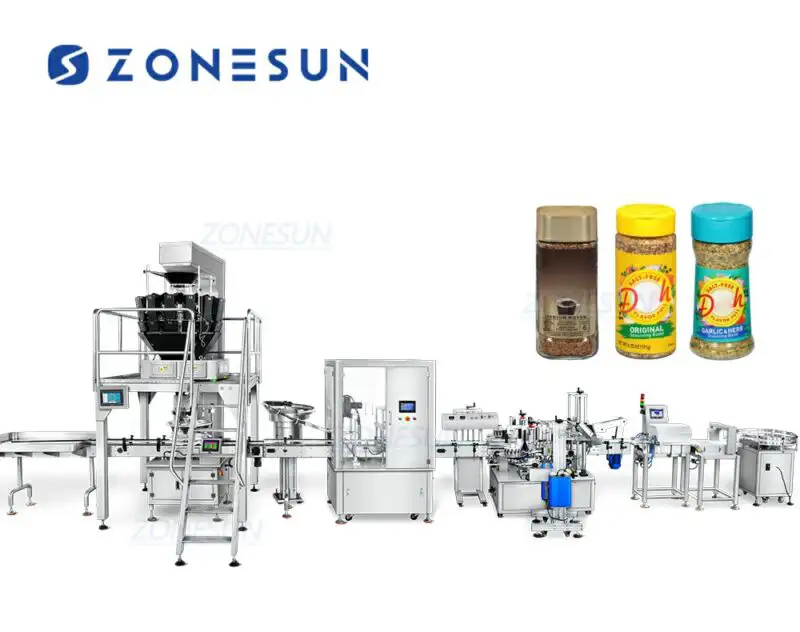
For manufacturers packaging seasoning and spice products in bottles, ZONESUN PACKAGING’s Automatic Seasoning Powder Spice Bottle Filling Line is a practical option. It is designed to integrate powder filling with other packaging processes, helping manufacturers handle multiple steps in a continuous production line. Key features can include:
- Product type: Seasoning powder and spices
- Package format: botellas
- Process: Automatic bottle filling and packaging
- Aplicación: Seasoning, spice, and other powdered food products
- Production: Suitable for automated continuous packaging
Conclusión
Food Packaging Equipment can package all kinds of food, including grains, snacks, powders, liquids, sauces, meat, seafood, frozen food, and prepared meals. These different foods can be packaged using proper filling, weighing, vacuuming, pouching, and sealing. With the correct packaging machinery, manufacturers can package various kinds of food efficiently and maintain consistent portions and packaging. For further questions on food packaging equipment or solutions, you can contactar con EMBALAJE ZONESUN.