English
  Russian
  Korean
  Indonesian
  Spanish
  Thai
Thai 

In the manufacture of soda, sparkling water, energy drinks, beer, and other carbonated beverages, there is a necessary piece of equipment: a carbonated filling machine. These beverages are pressure-sensitive, temperature-sensitive, and speed-sensitive. When selecting a suitable filler, the factors considered should include production volume, container, filling system, cleanliness, and future production requirements.
Carbonated Filling Machine Capacity and Production Needs
Production capacity is typically one of the key metrics that beverage manufacturers closely monitor and evaluate. The machine should match the target production output and can be connected with other packaging equipment for future growth.
Match Output With Actual Production
For higher production efficiency, the 12-head filling machine delivers consistent filling performance and can process up to 4,500 cans per hour. However, the production speed is not the only factor that needs to be considered. The whole production line needs to be viewed as one entity since having a fast filler machine compared to other machines on the production line will not ensure high production speed.
For smaller or medium-scale can production, the ZS-FAL180A11 Automatic Soft Drink Soda Can Filling And Sealing Machine offers an output of 1,000-2,000 BPH. The machine can work in tandem with labeling and box packing modules for building a complete integrated can packaging production line.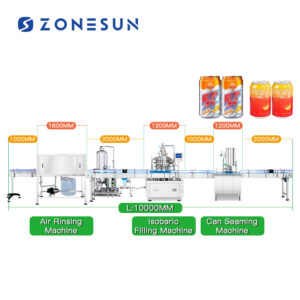
Its main features include:
- 12-head isobaric filling: Designed to regulate pressure during filling, minimizing CO₂ loss and ensuring reliable filling accuracy.
- Magnetic constant-torque seaming: Provides precise torque control during the seaming process for consistent and reliable sealing performance.
- Air rinsing system: Rinses the inside and outside of cans before filling to support cleaner production conditions.
- Empty can prevention function: The system identifies absent cans and stops redundant beverage outflow, effectively minimizing material loss.
- Can inverting system: Automatically adjusts can orientation to support smooth and continuous production.
Carbonated Filling Machine Container Compatibility
Selection of filling and capping processes is directly governed by container formats. The mainstream packaging for carbonated beverages contains aluminum cans and glass bottles. Different package formats require different equipment configurations.
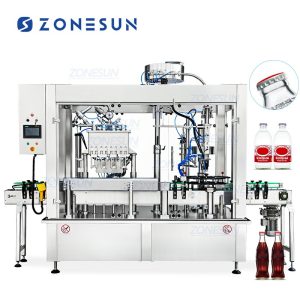 Aluminum Cans And Glass Bottles
The beverage can production line utilizes an integrated filling and seaming machine, and most of the equipment is equipped with a pre-purging air process. Glass bottles need monoblock units that integrate vacuuming, CO₂ injection, filling, and crown capping. The ZS-CFC4 monoblock automatic bottle filling and capping machine integrates the aforementioned functions into a single unit and is suitable for the filling and production of various carbonated beverages, such as beer, soda water, and soft drinks. Customizable configurations are available for different production needs.
Its main features include:
- All-in-one unit: Completes vacuuming, CO₂ dosing, filling, and capping in one station to streamline production.
- Reliable isobaric filling: Minimizes CO₂ loss and foaming; liquid level error within ±2.5mm for consistent fill volume.
- Empty-bottle detection interlock: Automatically cuts off liquid supply when no bottle is detected, reducing raw material waste.
- Fully adjustable components: Compatible with bottles ranging from 300ml to 1.5L and various crown caps.
- Line integration: Works with labeling machines to build a fully automated packaging line for carbonated glass bottles.
Carbonated Filling Machine Isobaric Filling Technology
For carbonated beverages, isobaric filling is a very important filling method. The basic principle of isobaric filling is to establish and maintain a controlled pressure state between the beverage can and the container before filling.
Why Pressure Control Matters
If the pressure varies during the filling process, carbon dioxide will come out of solution and generate a large amount of foam. This could affect the filling accuracy and reduce the product’s carbonation level. The isobaric filling system stably maintains pressure balance, ensuring a uniform fill level for carbonated beverages.
In addition, the important factor of temperature needs to be considered. Maintaining a low temperature of around 2-8°C before filling is a common practice for carbonated beverages.
Carbonated Filling Machine Hygiene and Product Safety
Hygiene is another important consideration for food and beverage manufacturers. Product-contact components should be manufactured from materials suitable for beverage processing, with 304 stainless steel commonly used for many machine structures and product-contact parts.
Cleaning and Rinsing Functions
Sanitized vessels are critical to sustaining sanitary manufacturing environments. The air-rinsing system removes dust and impurities from containers before filling, while the filling lines themselves also require comprehensive cleaning procedures. The following measures help control contamination risks and ensure the stability of the production system during long-term operation. A complete sanitation strategy may include:
- Container air rinsing
- Product-line cleaning
- Regularly inspect the filling nozzles and valves
- Appropriate CIP procedures where available
- Periodically replace seals and other wear parts
Carbonated Filling Machine Automation and Protection
Automated equipment can significantly enhance production stability, a benefit that is particularly pronounced for medium- to large-scale beverage manufacturing plants.
Useful Automation Features
In practical applications, the system typically integrates features such as automatic container detection, “no-bottle, no-fill” protection, pressure control, automatic cap feeding, and touchscreen control. The feature of no-fill protection can be especially useful since the machine will be able to detect the lack of a container and avoid discharging beverages unnecessarily.
This feature reduces product waste while keeping the filling station clean. In glass bottle filling applications, the use of automatic bottle loading and capping equipment can significantly reduce manual intervention during production.
Carbonated Filling Machine Customization and Future Expansion
Not every beverage manufacturer has the same production requirements. There can be remarkable discrepancies among different clients regarding container sizes, drink recipes, sealing styles, production targets, and plant layouts.
Evaluate Customization Before Purchase
Before selecting a carbonated filling machine, manufacturers should confirm whether key components can be adjusted to meet their production needs. This includes components such as filling valves, filling nozzles, valve assemblies, capping mechanisms, rinsing systems, and bottle conveying accessories.
Expansion must also be taken into account in the future. If production demands rise in the future, machines that only match your current output capacity may become a bottleneck. Machines that can provide adequate flexibility to accommodate further production without changing the entire packaging line can be considered.
Conclusion
Ultimately, the best carbonated filling machine is not necessarily the fastest, but the one that delivers stable carbonation control, accurate filling, reliable hygiene, and compatibility with the entire production line. ZONESUN PACKAGING offers highly adaptable, complete carbonated beverage filling solutions to meet the specific requirements of various beverages and packaging containers. If you have any questions or need help choosing the right configuration, our team is ready to assist.