English
  Russian
  Korean
  Indonesian
  Spanish
  Thai
Thai 

Product filling is a common process in modern factories and plays a key role in determining product quality and production efficiency. The filling process requires a great deal of accuracy, especially when dealing with products like shampoos, hand sanitizers, liquid bleach, and pesticides. With technological development, the chemical filling machine has become an important piece of equipment that chemical manufacturers must have to ensure efficiency and safety. The following is a comprehensive guide on daily chemical filling machines.
Overview of Daily Chemical Products
The overflow filling machine is the most suitable machine for low or medium-viscosity fluids. These chemical filling machines use the level-controlled system of fluids, which allows any excess fluid to be returned to the tank in order to ensure accurate filling. The overflow filling machines are extensively used for alcohol, sanitizers, and various cleaning solutions.
Viscosity Classification
Viscosity Level | Example Products | Characteristics |
Low | Alcohol, sanitizer, liquid bleach | Easy to flow, ideal for high-speed filling |
| Medium | Shampoo, hand soap, pesticide liquids | Moderate flow requires precise dosing |
| High | Hand cream, cleaning paste | Thick, needs accurate measurement and controlled filling |
Types of Daily Chemical Filling Machines
1. Overflow Filling Machines
The overflow filling machine is the most suitable machine for low or medium-viscosity fluids. These chemical filling machine use the level-controlled system of fluids, which allows any excess fluid to be returned to the tank in order to ensure accurate filling. The overflow filling machines are extensively used for alcohol, sanitizers, and various cleaning solutions.
Benefits:
- Quick filling process
- Easy operation
- Can handle constant fluid levels
2. Piston Filling Machines
The piston filling machine can work well with medium or high-viscosity liquids. It uses the principle of a piston that moves the liquid inside the bottle with maximum accuracy. This machine can work for shampoos, hand cream, and viscous chemicals.
Benefits:
- Accurate volume filling
- Works best for viscous liquids
- Multi-nozzle configuration possible
3. Rotary Lobe Pump Filling Machines
Rotary lobe pump machines are appropriate for thick or viscous liquids and products containing tiny solid particles. The pump draws the liquid from the tank and forces it into containers in exact amounts. It is commonly used in industrial chemical filling, for instance, of cleaning pastes and gels.
Advantages:
- Manages thick and particulate liquids
- Provides an accurate dose with minimal loss
- Automated production line-friendly
4. Anti-corrosion Filling Machines
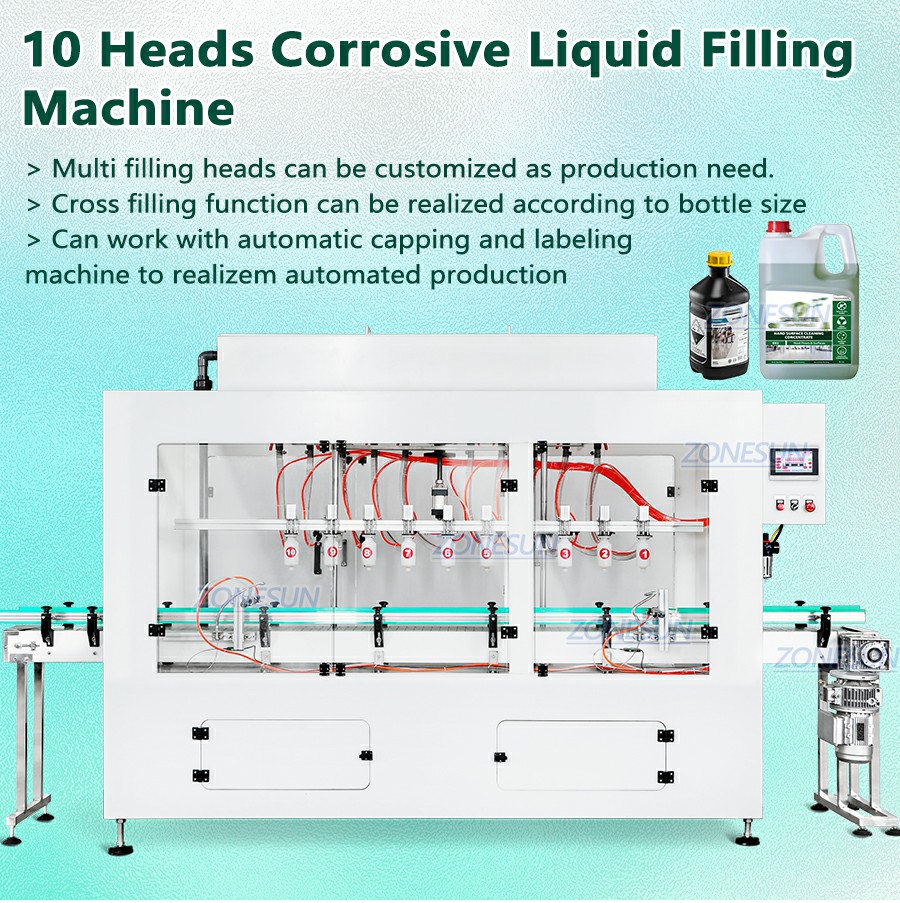
Anti-corrosion filling machines are designed for low to medium-viscosity liquids, corrosive chemicals, and agricultural chemicals. They can be designed with multiple filling heads to improve efficiency.
Advantages:
- Increases production rate
- Minimizes labor cost
- Suitable for mass production
Example Product:
ZONESUN ZS-YTCR10A 10-Nozzle Herbicide Filling Machine
- Designed for corrosive chemical liquids
- Equipped with an automatic feeding system and a dust cover
- Customizable nozzle numbers
- Can be integrated with capping and labeling machines for fully automated production
5. Explosion-Proof Chemical Filling Machines
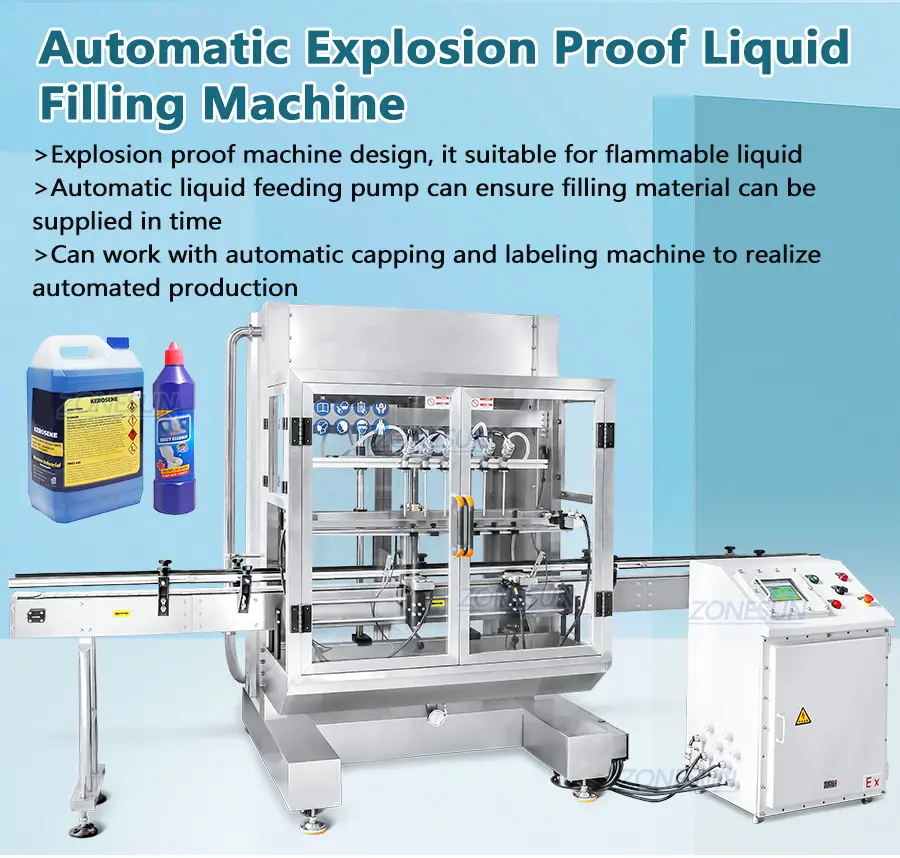
Filling explosion-proof machines are meant to be used for filling explosives or hazardous fluids like alcohol, bleach, and pesticides. Safety features of explosion-proof filling machines involve motor safety against explosions, seals, and spark-proof materials.
Advantages:
- Ensures safe handling of hazardous liquids
- Medium-speed production capability
- Applicable in automated production lines
Example Product:
ZONESUN ZS-YTEX1 6-Nozzle Pesticide Filling Machine
- Explosion-proof design for safety
- Fills 10-30 bottles per minute
- Compatible with capping and labeling systems for automated production
Basic Working Principle of a Chemical Filling Machine
The basic working principle of a chemical filling machine involves three primary processes:
1. Product Loading: Product is sucked from the tank using a piston or pump.
2. Accurate Filling: Product is dispensed into containers according to the predefined volume.
3. Recirculation Process: The excess amount of liquid is pumped back into the tank.
While machines differ, the principles behind their operation are similar – an accurate filling process.
How to Select the Right Chemical Filling Machine
Some tips on how to select an appropriate chemical filling machine:
1. Type of Product: Choose between overflow or magnetic pump system for low viscosity products; for high viscosity products, go for Piston or Rotor Pump Machine
2. Types of bottles: The characteristics of bottles, like shape, material, and size, determine the design of the nozzles
3. Required Production Rate: Select between single head and multiple heads, depending on the production rate required
4. Automation Requirements: Fully automatic machines for large production, Semi-automatic for small production
5. Safety requirements: Choose between explosion-proof and corrosion-resistant machines if it is a flammable and corrosive liquid
Conclusion
Chemical daily filling machines have become essential in modern chemical production industries. Awareness of different product features, types of packaging, and classifications of these machines will assist manufacturers in selecting the right daily chemical filling machine. This will contribute to their efficient operation and quality manufacturing. The emergence of new features like explosion protection has facilitated the safe filling of various liquids.