English
  Russian
  Korean
  Indonesian
  Spanish
  Thai
Thai 

The pharmaceutical packaging process requires precision in filling, high-quality product standards, and a controlled production environment. Filling can be challenging depending on the type of product and whether the manufacturing process is manual or automatic. To maintain accurate fill volumes, pharmaceuticals must use an effective and efficient filling process. The use of a Pharmaceutical Filling Line is vital in achieving an efficient production process in the industry.
1. What Is a Pharmaceutical Filling Line?
A Pharmaceutical Filling Line refers to the machinery used to automatically or semi-automatically pack pharmaceuticals in suitable containers. Depending on the application process, the line can incorporate other functions in addition to filling, such as rinsing, capping, sealing, inspecting, labeling, and cartoning, among others.
The configuration of the equipment may differ based on the needs of the manufacturer. Small companies producing a few hundred containers per batch may not have similar configurations as large manufacturers who operate continually. Product viscosity, filling volume, container design, required output, hygiene level, among other factors, determine the final configuration.
Understanding the Basic Structure
A typical Pharmaceutical Filling Line consists of different units. Each unit plays its own role while coordinating with other machinery in the process.
| Component | Main Function |
| Container Feeding System | Transfers empty containers to the filling station |
| Filling Machine | Dispenses a controlled amount of product |
| Capping Machine | Places and secures caps |
| Sealing Equipment | Provides additional container protection |
| Conveyor System | Moves containers between processing stations |
| Inspection System | Checks containers and filling results |
For instance, a liquid medicine line may combine a bottle unscrambler, filling machine, capping unit, and labeling machine. More complex production environments may also include automated inspection or other specialized equipment.
How Does a Pharmaceutical Filling Line Work?
The process normally starts with empty containers entering the feeding system. The containers are then transferred to the filling station, where a dosing mechanism delivers a predetermined volume of pharmaceutical product. After filling, containers move through capping or sealing equipment before continuing to inspection and labeling.
The filling method can vary according to the product. Other filling systems, such as piston, peristaltic, and ceramic pump, can be used depending on the properties of the liquid and volume requirements. For instance, a filling machine that fills 50 mL containers will have to ensure a constant 50 mL volume during the production process.
2. What Are the Benefits of Using a Pharmaceutical Filling Line?
Improves Production Efficiency
The Pharmaceutical Filling Line can unite several production stages in one cycle without the necessity to manually handle the products between different machines. For companies that need to fill many pharmaceutical vials, separate filling, stoppering, capping, and labeling stages may impede production and demand more operator interaction. The use of automation will help synchronize all these operations, ensure consistent filling cycles, and decrease unnecessary product handling.
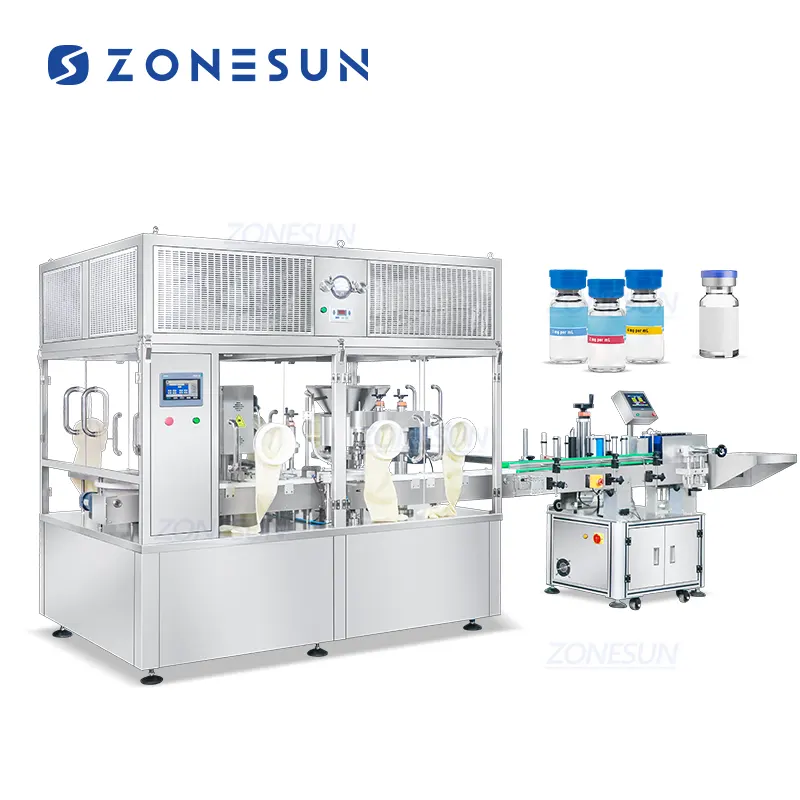
For manufacturers looking to simplify vial packaging and improve production efficiency, the ZONESUN PACKAGING ZS-AFCL9 Automatic Pharmaceutical Vial Filling Line is a practical choice. Its key features include:
- 3,600–4,800 BPH output for high-volume vial production.
- Integrated filling, stoppering, capping, and labeling to streamline the packaging process.
- Servo-driven peristaltic pump for controlled and precise filling.
- Laminar flow hood to support a cleaner filling and capping environment.
- Optional vial rinsing machine and date coder for additional production requirements.
- Customizable configuration to match different production needs.
Improves Filling Accuracy and Consistency
One of the most important benefits of a Pharmaceutical Filling Line is its ability to maintain consistent filling results. Pharmaceutical products require controlled dosing because excessive or insufficient filling can affect product quality and material utilization.
Automated dosing systems can control filling parameters more precisely than manual operations. Depending on the filling technology and product characteristics, manufacturers can configure equipment for specific volume ranges and accuracy requirements.
Consider a production run involving 50,000 containers. If each container is overfilled by only 1 mL, approximately 50 liters of product could be unnecessarily consumed. Accurate dosing therefore helps manufacturers control both product consistency and material waste.
Reduces Production Costs
Automation can also contribute to lower long-term production costs. By reducing repetitive labor, improving filling consistency, and minimizing product losses, a Pharmaceutical Filling Line can make better use of manufacturing resources.
The financial impact can be evaluated through several factors:
| Cost Factor | Potential Improvement |
| Labor | Less repetitive manual handling |
| Product Waste | More consistent dosing |
| Production Time | Continuous automated operation |
| Material Handling | Reduced manual transfer |
| Downtime | Better process coordination |
Instead of evaluating equipment only by its purchase price, manufacturers should consider its expected operating hours, output, maintenance requirements, and potential material savings.
Improves Hygiene and Contamination Control
Pharmaceutical products are sensitive products, such as eye drops. In pharmaceutical production, hygiene control is vital. Frequent manual handling during filling, plug feeding, and capping can increase direct contact with the product and make cleanliness more difficult to maintain. A properly designed Pharmaceutical Filling Line can reduce unnecessary operator intervention and provide a more controlled filling process.
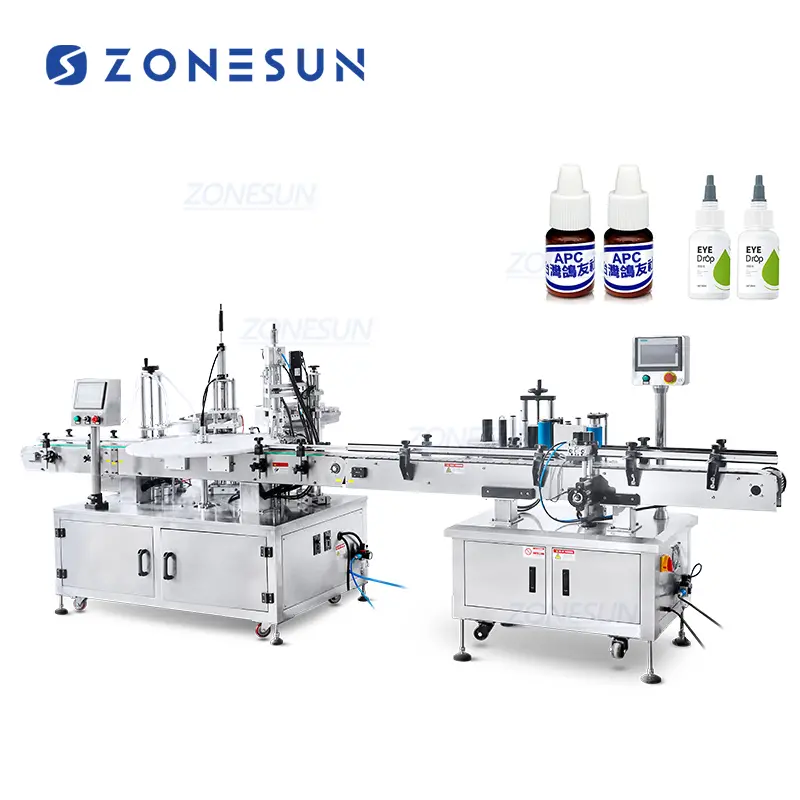
For eye drop manufacturers seeking to improve product cleanliness, the ZONESUN PACKAGING ZS-FAL180A10 Automatic Eye Drops Bottle Filling Capping Labeling Machine is a suitable choice. Its key features include:
- Peristaltic Pump Filling— Keeps the liquid inside the tubing during filling, helping reduce direct product contact.
- Automatic Liquid Filling — Provides consistent filling while reducing manual handling.
- Inner Plug and Cap Feeding— Automates plug and bottle cap handling for a more controlled process.
- Integrated Capping and Labeling— Combines multiple packaging steps in one production line.
- Flexible Labeling Options— Supports single-side, double-side, and full-wrap labeling for round bottles.
- Customizable Configuration— Can be adjusted according to bottle specifications and production requirements.
Facilitates Flexible Pharmaceutical Production
Pharmaceutical companies usually need to produce a variety of formulations and packaging types. A flexible Pharmaceutical Filling Line can easily adapt to these changes. Cause it has adjustable filling parameters, interchangeable components, and correct changeover procedures.
For instance, one company may need to fill 10 mL, 30 mL, and 100 mL containers. Machines that allow adjustment of filling volume and handling of various types of containers will simplify this process. This flexibility is particularly useful for manufacturers handling multiple product formats. It allows production resources to be used more effectively without requiring completely separate equipment for every packaging specification.
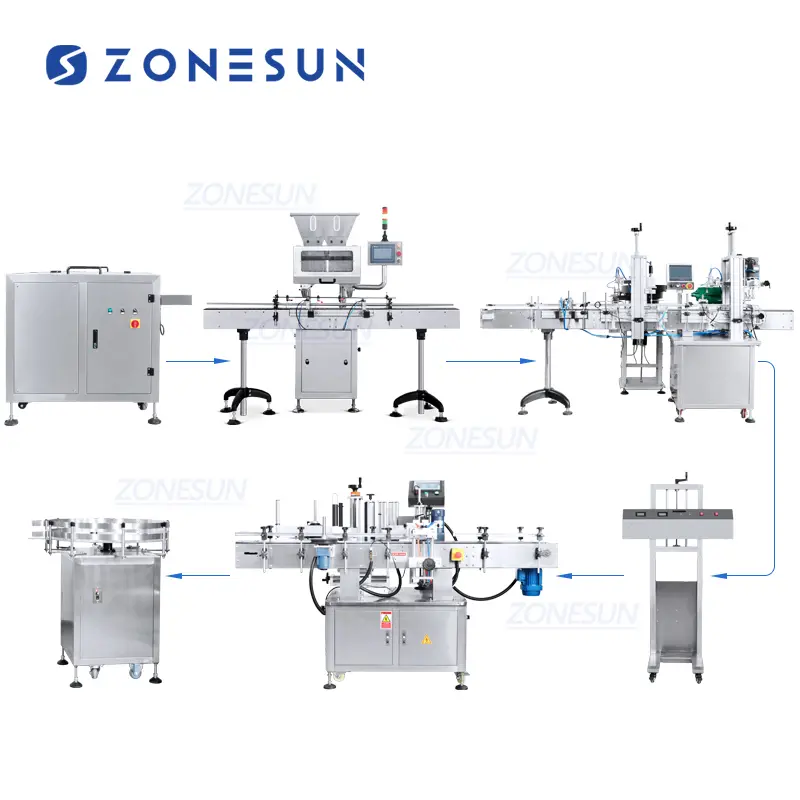
For manufacturers that want to automate capsule and pill packaging production, the ZS-FAL180B6 Automatic Fish Oil Capsule Counting And Filling Line is an ideal choice. Its key characteristics include:
- With a counting and filling system for accurate measuring of capsules or pills.
- With dual capping structures for handling screw-type and press-type bottle lids.
- With an induction sealing system to seal the foil lids inside the caps and create a tamper-proof seal.
- With bottle sorting machines to arrange the bottles at the start and the end of production.
- Customizable according to your materials, bottle and cap sizes, and targeted output.
3. How to Choose the Right Pharmaceutical Filling Line?
Consider Filling Volume and Production Capacity
The first step is to determine the required filling volume and expected production output. A manufacturer producing 1,000 containers per hour will have different equipment requirements from a facility targeting 6,000 containers per hour.
Manufacturers should calculate:
- Target filling volume
- Containers per hour
- Number of production shifts
- Expected annual output
- Future capacity requirements
Choosing equipment based only on maximum speed can result in an unsuitable system if the actual production requirements are much lower or higher.
Check Filling Accuracy and Automation Level
Filling accuracy should match the characteristics and requirements of the pharmaceutical product. Manufacturers should examine the dosing technology, control system, repeatability, and available adjustment functions. The required automation level is also important. Semi-automatic equipment may be suitable for smaller production volumes, while high-volume manufacturing generally benefits from a more integrated automated system.
Consider Container Compatibility
Container dimensions and materials directly affect equipment selection. Before purchasing a Pharmaceutical Filling Line, manufacturers should confirm compatibility with the intended bottles, vials, or other containers. If multiple container formats are required, convenient changeover should also be considered.
Important specifications include:
- Container diameter and height
- Filling volume
- Container material
- Neck size
- Cap or closure type
Evaluate the Cleanliness and Maintenance of the Equipment
Cleanliness and maintenance directly influence the efficiency of the production process. It is necessary to evaluate how easily the equipment will be cleaned and maintained. This is important when the same line is used to manufacture different pharmaceutical products. Manufacturers need to consider factors such as inspection frequency, spare parts availability, ease of operation for personnel, and technical support.
4. Conclusion
The Pharmaceutical Filling Line enhances pharmaceutical production with features of precise filling, automation, better hygiene control, and consistent final products. When selecting the right equipment, the manufacturer needs to pay attention to such aspects as filling volume, production capacity, containers, automation, and maintenance. For professional filling and packaging solutions, ZONESUN PACKAGING can provide suitable equipment and guidance. Feel free to contact us with any questions about pharmaceutical filling systems.