English
  Russian
  Korean
  Indonesian
  Spanish
  Thai
Thai 

In the contemporary packaging industry, the jar capper machine becomes an integral part of ensuring optimal product quality, proper sealing, and production efficiency. In the case of the food, beverage, or cosmetics industries, the sealing process affects the shelf life of products and their ability to be safely transported and delivered to customers.
At present, two approaches can be applied: Each type of jar capping machine is designed for different production goals, especially when balancing product preservation needs and production capacity.
This guide explains both technologies in detail and helps manufacturers choose the most suitable jar capping machine based on real industrial applications.
1. What Is a Vacuum Jar Cap?
The vacuum jar cap is the process of sealing that creates a vacuum in the jar prior to its closure. This technique eliminates much of the oxygen from the package,which delays the process of oxidation of goods and increases the shelf-life of the products. It is mainly applied to premium quality food packaging, such as sauces, jams, and beverages.
In a vacuum system, the jar capping machine is responsible not only for tightening the lid but also for coordinating vacuum extraction and sealing in one integrated process. It can help to create a stable low-oxygen environment in the container.
Key characteristics of vacuum sealing include:
- Strong oxidation resistance
- Shelf life extension of approximately 30%–80%depending on product type
- Improved product appearance and stability
- Suitable for export-grade packaging requirements
2. What Is a Standard Jar Cap?
A standard jar cap does not involve vacuum processing. Unlike this, it concentrates mainly on fast and uniform capping in order to achieve proper sealing of the containers during their massive manufacturing.
In this system, the jar capping machine mainly handles automatic cap feeding, positioning, and torque-controlled tightening. The goal is to maintain production speed and sealing consistency rather than modifying internal jar conditions.
Key characteristics include:
- High production efficiency
- Simplified machine structure
- Lower maintenance requirements
- Suitable for large-scale continuous production
In industries such as honey or syrup manufacturing, standard capping is widely used where output volume is more important than vacuum preservation.
3. When to Use the Vacuum Jar Capping Machine ?
Vacuum sealing machines are required to be used in cases where preserving the taste and quality of the goods plays the most important role.
This approach proves to be more useful, for instance, in the case of medium-scale manufacture of glass bottle chili sauce or fruit jam, where products must stay fresh throughout the long-distance transportation.In this scenario, a vacuum-based jar capping machine becomes the ideal solution.
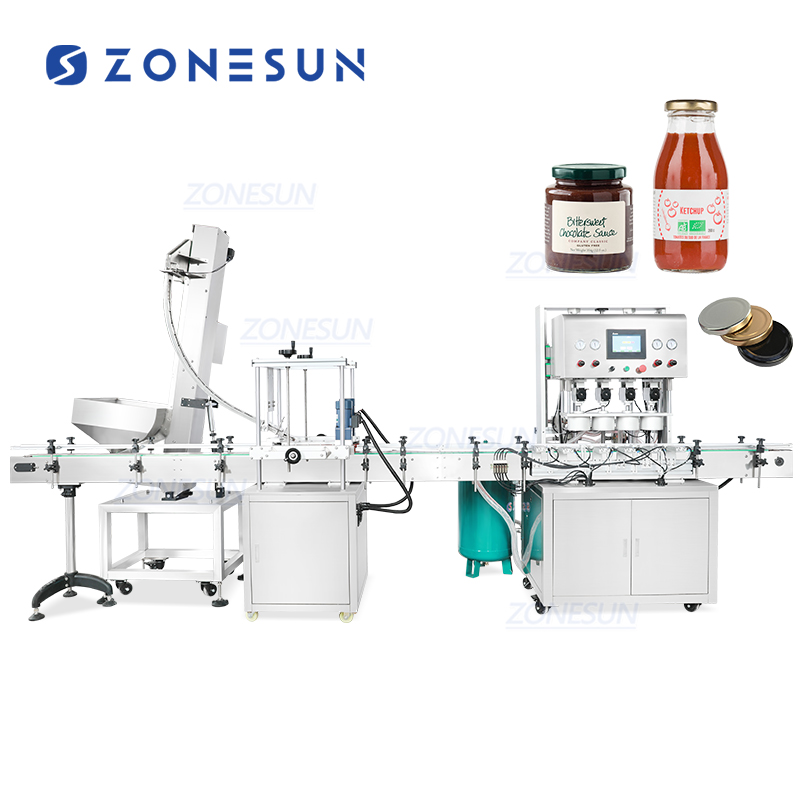
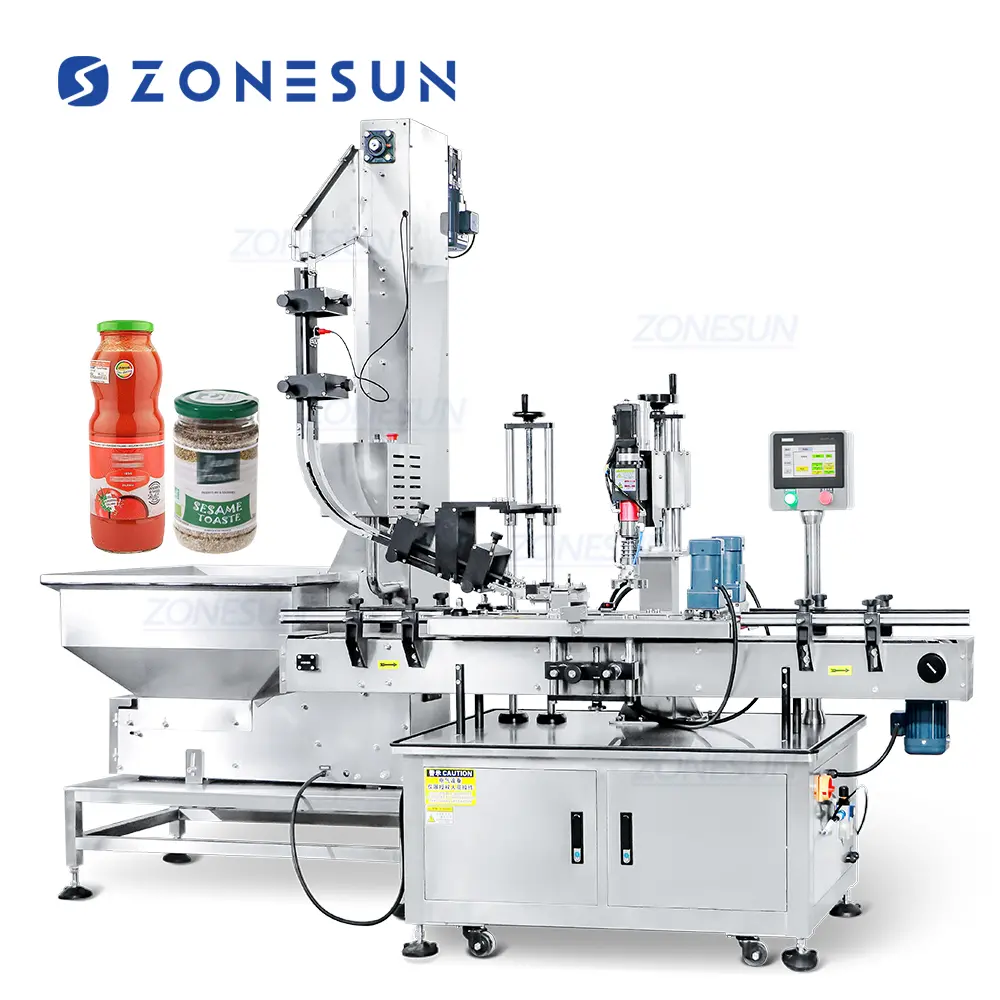
A practical industrial example is the ZS-XGVS1 Automatic Vacuum Capping Machine for Glass Bottles from ZONESUN. This equipment is designed for integrated cap feeding and vacuum sealing operations.
Key technical features include:
- Production capacity: 1200–2400 BPH
- Automatic cap feeding system
- Integrated vacuum sealing process
- Touchscreen operation interface
- Customizable cap head design
- Compatible with filling and labeling production lines
For a typical production process in practice, the process of running a jam factory can be:
- Filling machine output: ~2000 BPH
- Vacuum sealing via jar capping machine: 1200–2400 BPH
- Automatic labeling and packing integration
In this setup, the jar capping machine ensures that each glass jar is sealed in a vacuum state. This helps to improve the product’s shelf stability. Therefore, it is quite appropriate for the packaging of exported foodstuffs and luxurious products in jars.
4. When Should We Use a Normal High-Speed Automatic Jar Capping Machine?
When production requirements shift toward large-scale output and continuous operation, speed becomes more important than vacuum preservation. In such cases, a high-speed mechanical sealing system is preferred.
In cases of a large-scale jam manufacturing facility with a daily output of 10,000 to 50,000 units, manufacturing productivity would be the key factor. Here, a high-speed jar capping machine is required to handle continuous sealing without production bottlenecks.
The ZS-XG440T Automatic Glass Fruit Jam Jar Lug Capping Machine from ZONESUN is designed specifically for this type of application.
Key features include:
- Automatic cap feeding system for metal lug caps
- Servo motor torque control for stable tightening
- Touchscreen control panel with customizable language
- Adjustable capping head for different jar sizes
- In a typical jam production line, the workflow may include:
- Filling system: 100–150 bottles/min
- Capping system: synchronized high-speed operation
- Labeling system: fully automated integration
5. Industrial Applications of Jar Capping Machine
The jar capping machine is widely used across multiple industries, each with different sealing requirements:
- Food Industry: jam, honey, sauces, preserved foods
- Beverage Industry: bottled drinks, glass container beverages
- Cosmetic Industry: creams, lotions, skincare products
- Daily Chemical Industry: gels, cleaning liquids, care products
Each application requires different sealing strength, production speed, and automation level. Therefore, selecting the right jar capping machine is essential for ensuring stable production performance.
6. What is the Correct Jar Capping Machine for You?
Choosing the right equipment depends on several key industrial factors:
6.1. Product Preservation Requirements
- Oxygen-sensitive products → vacuum sealing system required
- Stable products → standard sealing is sufficient
This is the most important factor when selecting a jar capping machine, as it directly affects product quality.
6.2. Production Capacity
- Small to medium production → 1200–2400 BPH systems
- Large-scale production → 80–150 bottles/min high-speed systems
6.3. Packaging Type
- Glass jars need precise torque and high stability
- Metal lug caps require strong tightening force control
6.4. Production Line Integration
Modern factories often integrate the jar capping machine with filling, labeling, and case packing machines to create fully automated production. This usually helps to enhance production efficiency.
7. Conclusion: Choosing Based on Product Preservation Needs
In a word, vacuum sealing and standard capping serve different products. When selecting the jar capping machine, it is better to consider the product characteristics and the required production capacity.
The vacuum system is a good choice for businesses that take freshness, shelf life, and product quality very seriously. For those companies that require efficient operations and continuous productivity, the standard high-speed system can become a preferred option.
If you are looking for a suitable jar capping machine for your production line or need a customized packaging solution, ZONESUN can provide professional technical support and tailored recommendations.
Do not hesitate to contact us in case of any questions.