English
  Russian
  Korean
  Indonesian
  Spanish
  Thai
Thai 

For pharmaceuticals, biochemicals and cosmetics, precision is a regulatory requirement. Manufacturers use precise and automated systems to realize contamination packaging of medicines, laboratory reagents or high-value serums. One of the most critical technologies that support this process is the monoblock vial filling machine. The highly engineered systems have become the backbone of modern pharmaceutical production lines. They help to reduce human intervention and maintain compliance. In this article, we will discover different types of vial filling machines and their workflow.
What Is A Monoblock Vial Filling Machine?
Monoblock vial filling machine is an integrated system. It can automatically receive empty vials, fill them with a precise volume of liquids or powders, insert stoppers, and seal the caps. These processes are all with minimal human intervention. The equipment is featured with advanced PLC control system and touch screen, which allows operators to manage settings effortlessly.
How Does A Monoblock Vial Filling Machine Work?
A modern automatic vial filling machine is an interconnected system. While setups may vary, its workflow typically follows these steps:
1. Vial Infeeding: Empty vials will be loaded onto a turntable or conveyor. Then they will be orderly arranged and moved to filling station.
2. Vial Filling: When vials are moved under the filling heads, the filling machine will start to dispense materials. The vial filling machine will adhere to “No Vial, No Fill” This avoids product waste.
3. Stoppering or Plugging: The vibratory bowl will continuously supply stoppers and a vacuum mechanism will accurately drop the stoppers onto the vials. In some occasion, manufacturer will choose half stoppering, making the vials ready for lyophilization process.
4. Capping or Sealing:The stoppered vials will be moved to capping station, where the aluminum caps will be crimped tightly around the bottle neck. This ensures tamper-evident security.
5. Discharge and Inspection:The sealed vials will be guided to an outfeed tray. Many modern lines are equipped with vision inspection system to remove the vials with incorrect fill levels or loose caps.
What Are Types of Monoblock Vial Filling Machines?
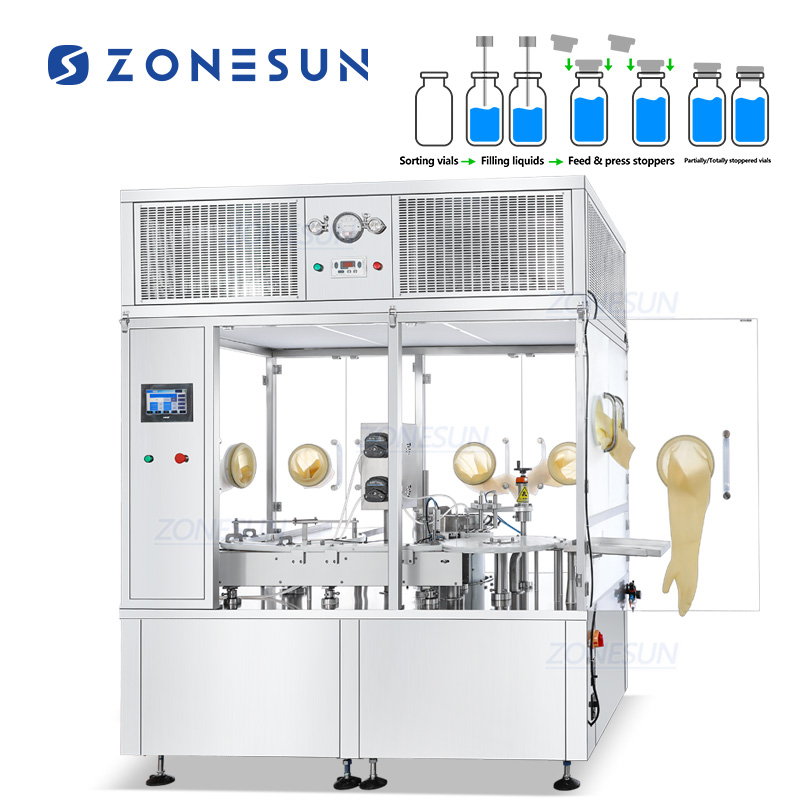
ZS-AFC9H Monoblock Automatic Vial Filling And Stoppering Machine – This model integrates with functions of arranging, filling and stoppering vials. It can be adjusted for fully or partially stoppering. The machine comes with laminar flow hood design to ensure production quality.
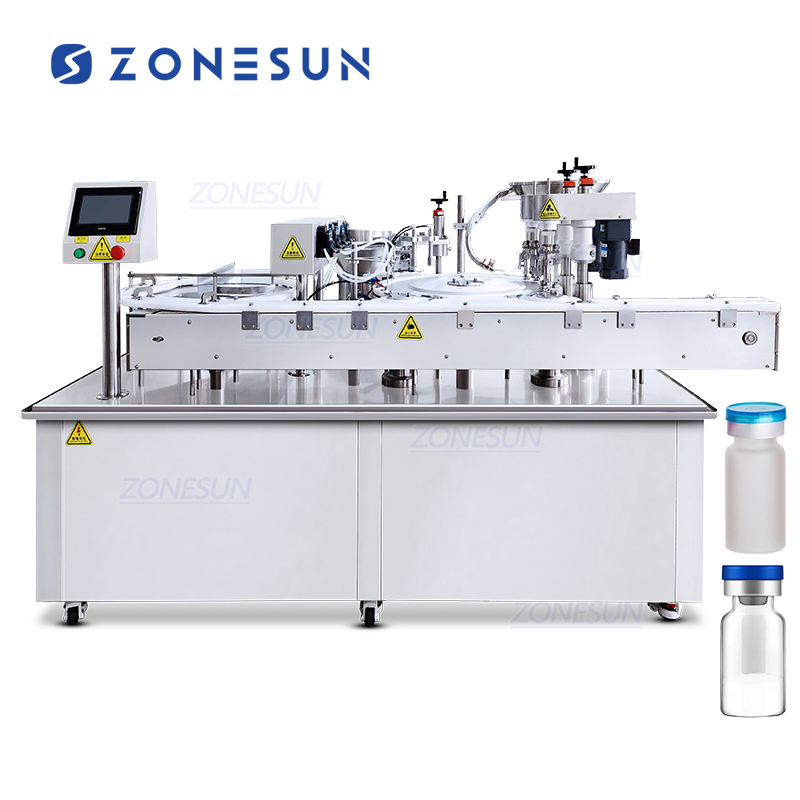
ZS-AFC39 Rotary Automatic Liquid Vial Filling And Capping Machine – This model combines functions of arranging vials, filling liquids, stoppering vials, and crimping aluminum caps. It is equipped with two vibratory bowls that can continuously supply rubber stoppers and aluminum caps. The machine supports customization for various sizes of vials.
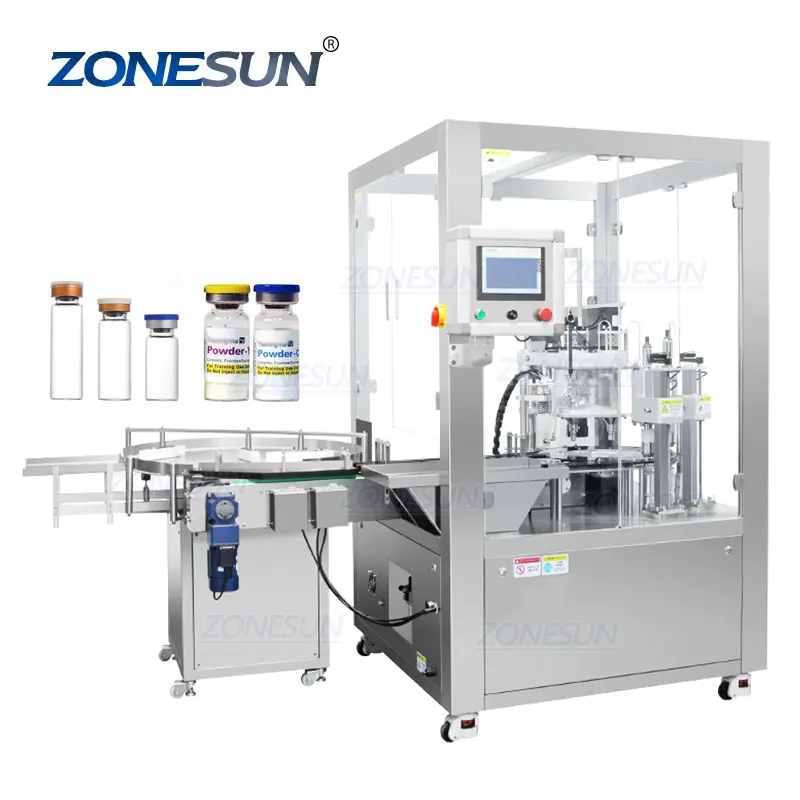
Monoblock vial filling machine can also work with vial labeler – ZS-AFCL9 Automatic Pharmaceutical Vial Filling Line: Can complete automatic processes of filling, stoppering, capping and labeling. Equipped with cam-controlled filling and capping system, the filling line can reach at high output of 1800-3600BPH.

ZS-AFC29 Automatic Powder Vial Filling And Capping Machine – This model is designed for filling powders into vials and sealing the vials. It is built with auger filling system that can realize precise powder dosage. The machine can also work with vial rinser and labeler machines to complete automation.
Video of Monoblock Vial Filling Machine Running
What Are Key Advantages of Monoblock Vial Filling Machines?
1. Improved Output and Efficiency
The most obvious benefit is throughput. Human speed is limited, which can only handle 600-900 vials per hour. However, an automatic monoblock vial filling machine can easily handle 2400-3600 vials per hour.
The advanced models usually come with quick-changeover parts. This allows operators to switch between different vials with less effort.
2. High Precision and Consistency
When filling expensive pharmaceuticals or potent chemicals, it is vital to maintain the filling accuracy.
Accurate Dosage: Monoblock vial filling machines often use high-precision pumps, like peristaltic pumps or ceramic pumps. This ensures that every single vial can receive the exact same volume, so as to eliminate under-filling or over-filling.
Zero Spillage: The machine’s nozzles can dive into the vials and avoid material drips.
3. Enhanced Production Hygiene
In pharmaceutical industry, contamination can ruin the entire batches and violate strict regulatory standards. An automatic vial filling machine can minimize human contact with the products. And it is usually equipped with laminar flow hood and dust-proof enclosure, which offers a clean working environment and enhance hygiene.
4. Data Logging and Tracking
The automatic systems can track production metrics and log batch data. This makes it easy for regulatory audits and quality control. What’s more, the working parameters can be saved as “recipes” in the PLC system. This allows for instant recall.
Future Trends in Vial Filling Technology
The future of vial filling equipment is moving toward smarter and more connected systems. Key trends include:
- AI-driven quality inspection
- Robotics integration
- IoT-enabled predictive maintenance
- Real-time production analytics
- Fully isolated aseptic filling systems