 English
 Russian
 Korean
 Spanish
 Japanese
 Polish
 Thai
 Indonesian


In the food processing and seasoning industry, a competitive company needs to ensure efficient packaging, accurate dosing, and attractive product appearance. Seasonings can be in powdered forms or granulated forms. Processing fine powders or bulk granulated spices requires different machines. It is crucial to pick a multi-purpose spice packing machine that can accommodate various containers and bags required for different types of customers – retail supermarkets, foodservice distributors, and industrial food producers. Awareness of different packaging formats will help manufacturing companies to arrange their premises optimally and avoid food loss during packing.
1. Formats of Flexible Pouches and Bags Processed by a Spice Packing Machine
Flexible packaging is used in both retail and wholesale spice markets. It features low weight and moisture-proof characteristics. A state-of-the-art spice packing machine is capable of forming, filling, and sealing different shapes of bags, which can maintain hermetic seals that will keep volatile essential oils inside.
Pillow Pouches and Stick Packs
These bags are best suited for single-serve packs and seasoning packs for households. Stick packs are popular for instant coffee powders, single-serve salts, and granulated sugars, which are made from a continuous roll of films at speeds above 60-80 packs per minute.
Stand-Up Pouches (Doypacks)
Bottom gussets enable bags to stand up on supermarket shelves, as well as zippers that can be closed again.
Gusseted and Quad-Seal Bags
Designed for mid-to-large retail or wholesale volumes ranging from 500g to 5kg, utilizing reinforced side folds to safely support dense powders and whole spices.
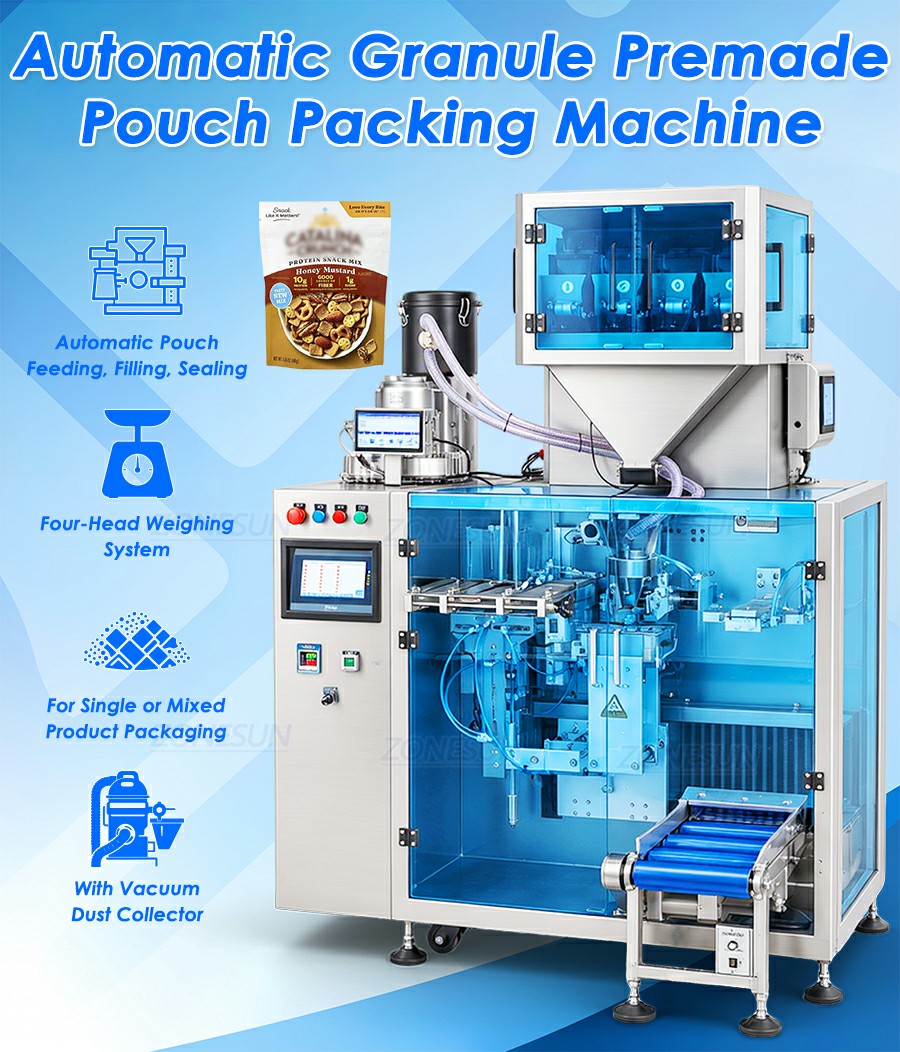
When working with ultra-fine powders that easily aerate and create airborne dust, specialized containment and dosing mechanisms become essential. For instance, many seasoning producers rely on equipment such as the ZONESUN PACKAGING compact dried bone broth spice pouch packing machine with a dust cover. This spice packing machine pairs an enclosed anti-dust housing with a precision auger filler to cleanly dose fine culinary broth powders into pouches, keeping sealing jaws free of powder residue that could compromise seal integrity.
2. Rigid Container Formats Accommodated by a Spice Packing Machine
Though flexible bags are economical, rigid packaging containers exhibit superior resistance to compression, moisture intrusion, and UV degradation. The automated spice packing machine line includes an auger filler/multi-head weigher together with a bottle unscrambling, capping, and labeling station for a continuous bottling process.
Glass/Plastic Spice Bottles
Cylindrical/square bottles between 50 ml and 500 ml are common in the kitchen; however, they need an anti-drip filling nozzle to keep the threads of the bottle clean before being capped.
Paper Composite Cans/Tinplate Tins
Often used for premium and export-quality seasoning mixes that need high barrier properties.
Dual Lid Shaker Bottles
Bottles that come with sifter plugs which are used for sprinkling and spooning. These bottles require indexing, inner plug pressing, and consistent capping torque.
In high-speed industrial bottling plants, an automated packaging line reduces the multiple steps of handling the containers. A good example is the ZONESUN PACKAGING automatic seasoning powder spice bottle filling line, which is a spice packing machine that integrates automatic bottle unscrambling, servo-driven auger filling, inner plug pressing, and screw capping of glass/PET spice jars.

3. Industrial bulk/sachet forms handled by the spice packing machine.
Apart from the normal forms on the retail shelf, central kitchens, restaurant chains, and secondaries in food production need bulk bags and condiment sachets. A good spice packing machine should be made of sturdy construction with a high-torque motor system.
Large Pillow Pouches and Flat Bottom Bulk Pouches
Pouches available between 2 kg and 10 kg, designed for restaurant back-of-house supply chain applications where high tear and puncture resistance is needed.
Single Portion
Packages that are sealed on three to four sides with tear notches; commonly used for takeaway foods, noodles flavorings, and quick-service restaurant condiments.
Bulk Drum Liners & Inner Liners
Packages designed for shipping raw spices from their primary source to the commercial food processing plant.
Handling coarse, abrasive, or irregularly shaped spices—such as whole black peppercorns, crushed chili flakes, or coarse sea salt—requires robust feeding mechanisms that prevent bridging and product breakage. Equipment like the ZONESUN PACKAGING vertical black pepper bagging machine with a material feeder illustrates how a dedicated spice packing machine uses multi-head combination weighers alongside a pneumatic bucket elevator to smoothly convey and pack whole spices into vertical pillow or gusseted bags without jamming or crushing the peppercorns.

4. Key Technical Considerations When Selecting a Spice Packing Machine and Format
Choosing the right container style and spice packing machine configuration involves balancing marketing goals with strict packaging engineering parameters:
Material Rheology and Bulk Density
Ultra-fine spice powder (with bulk density 0.4 – 0.8 g/cm³) is a very airy material and tends to form bridges inside hoppers; therefore, a positive displacement auger filler should be used to fill these pouches. In contrast, free-flowing whole seeds and granular seasonings can be easily weighed by using volumetric cups or multi-head combination weighers that operate with tolerances of ±0.5% to 1%.
Packaging Film Barrier Properties
Hygroscopic ingredients, such as onion powder, garlic powder, and sugar-based BBQ rubs, easily take in moisture from the air, thus coalescing. To avoid moisture uptake, it is necessary to package hygroscopic ingredients in multi-layer films that contain an AL layer or EVOH high-barrier layers with very low WVTR and OTR properties.
Line Speed & Dust Collection
Standard high-speed pouch packaging lines use VFFS machines that operate at a speed of 40 to 80 pouches/minute/lane, and the jar filling line will require anti-drip shutoff nozzles, vacuum dust collection port, and capping torque control.
| Packaging Format | Typical Capacity Range | Primary Sealing Method | Ideal Spice Applications |
| Stick Packs | 1g – 15g | Vertical Fin/Lap + Horizontal Heat Seal | Instant broth powder, single-serve pepper, fine salt |
| Retail Pillow Pouches | 50g – 500g | Constant Heat / Impulse Sealing | Chili powder, curry powder, garlic powder |
| PET / Glass Spice Jars | 100g – 400g | Induction Foil Liner + Screw Cap | Paprika, cinnamon powder, dried oregano flakes |
| Zipper Stand-Up Pouches | 250g – 1kg | Resealable Zipper + Top Heat Seal | Barbecue rubs, gourmet seasoning blends |
| Commercial Bulk Bags | 1kg – 10kg | Heavy-Duty Pneumatic Wide Heat Seal | Whole black peppercorns, star anise, dried herbs |
Conclusion
Ultimately, a well-matched spice packing machine can handle virtually the entire spectrum of seasoning packaging, from 1g single-serve stick packs and retail stand-up pouches to rigid glass jars and 10kg commercial bulk bags. By aligning the dosing mechanism with particle flow characteristics, selecting barrier materials suited to moisture sensitivity, and choosing modular equipment that supports fast format changeovers, food manufacturers can boost line efficiency while preserving the natural aroma and color of their spices.
If you have any questions about selecting the right packaging format or configuring your seasoning packaging line, feel free to contact us at ZONESUN PACKAGING anytime!


