English
  Russian
  Korean
  Indonesian
  Spanish
  Thai
Thai 

Selection of appropriate mixing machines is crucial for achieving consistency of products, increasing production efficiency, and lowering costs. There are certain requirements regarding mixing processes in different industries, such as viscosity of liquids, materials used, speed, temperature, and manufacturing volume. Inappropriate equipment could lead to a poor mixing process, unnecessary expenditure of energy, and problems in machine operation.
An industrial tank mixer is widely used in such industries as chemical production, the food and beverages industry, cosmetics and pharmaceuticals, and water treatment plants. As each of them uses different materials and has its own working conditions, selection of the appropriate mixing device is impossible without clear knowledge of the product features and demands of the manufacturing process.
In this article, you can find information on what factors should be taken into account while selecting an industrial tank mixer.
Understand Material Characteristics Before Selecting a Mixer
The first step in selecting an industrial tank mixer is understanding the properties of the material being processed. Different liquids require different mixing forces, materials, and equipment structures.
Consider Liquid Viscosity and Density
The viscosity of the liquid determines the mixing efficiency and directly affects the selection of a suitable industrial tank mixer. Liquids with low viscosity such as water, beverages, and some chemical liquids, will use conventional impellers and low mixing speed. But liquids with high viscosity like cream, gels, and emulsions need more torque for mixing.
Typical mixing speed ranges include:
- Low-viscosity liquids: approximately 100-500 RPM
- Medium-viscosity materials: approximately 50-300 RPM
- High-viscosity products: usually require lower speed with higher torque output
Choosing equipment based on viscosity helps achieve uniform mixing while reducing unnecessary energy consumption and mechanical stress.
 Select Suitable Materials for Chemical Compatibility
The material of the mixing tank and internal components should match the characteristics of the processed liquid. Some chemicals may react with stainless steel, while other applications require specific materials for safe and stable operation.
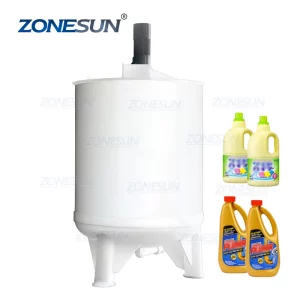
In the case of corrosive liquids like acid or alkali, a good solution for you would be the PP Industrial Acid Chemical Mixing Tank With Agitator. This type of mixing tank, which is made of polypropylene (PP), is highly resistant to chemical corrosion when compared to other metal tanks. Additionally, the adjustable mixing speed of this tank makes it highly efficient.
Key features include:
- Polypropylene construction with strong resistance to acids, alkalis, and corrosive chemicals.
- Adjustable mixing speed to support different processing conditions.
- Suitable for chemical manufacturing and industrial liquid applications.
- Durable and lightweight structure for long-term operation.
- Customizable tank sizes and agitator configurations.
Choose the Right Mixer Type for Your Application
Different industries require different mixing methods. Understanding common mixer designs enables manufacturers to select the equipment that matches their production goals.
Top Entry Mixers for Large-Scale Processing
Top entry mixers are commonly used in industrial applications where large volumes of liquid require continuous circulation. The industrial tank mixer is installed on the top of the tank and creates controlled fluid movement through rotating impellers.
These mixers are widely used for:
- Chemical storage and processing tanks
- Water treatment systems
- Industrial coatings
- Large-volume liquid blending
By selecting different impeller designs, top entry mixers can handle various viscosity levels and improve overall mixing efficiency.
 High-Shear Mixing for Emulsification Applications
For certain product lines, mixing is not enough – there needs to be emulsifying, homogenizing, or consistency improvement in texture. Cosmetics and food industries, as well as that of personal care products, often make use of high shear mixers.
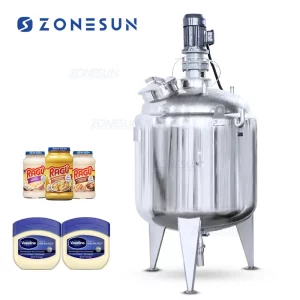
As an example, the Customized Stainless Steel Shampoo Juice Liquid Mixing Tank is made for mixing shampoos, creams, beverages, and lotions. Constructed from stainless steel, it has properties of being durable and functioning steadily. The equipment can also be designed with other features like emulsification, heating, and homogenization depending on needs.
Key features include:
- Durable stainless steel material used in production.
- Able to accommodate liquid products such as shampoos, creams, beverages, and sauces.
- Can perform other processes like emulsion, heating, and homogenization.
- Consistently mixes materials, hence ensuring quality of the product.
- Customized according to production requirements.
Match Tank Capacity and Mixing Power With Production Requirements
Tank capacity and motor power directly affect mixing efficiency. A properly selected industrial tank mixer should provide enough circulation force without causing excessive turbulence or unnecessary power consumption.
Determine the Required Motor Power
When selecting a industrial tank mixer, manufacturers should consider:
- Working tank volume
- Material viscosity
- Required mixing intensity
- Processing time
- Production frequency
For reference:
| Production Scale | Typical Capacity | Recommended Mixing Requirement |
| Small-scale production | 100-500 L | Compact mixer with moderate power |
| Medium production | 500-5,000 L | Adjustable-speed mixing system |
| Large industrial production | Above 5,000 L | High-torque industrial mixer |
Selecting the correct motor size prevents problems such as incomplete mixing, motor overload, and unnecessary operating costs.
Consider Mixing Time and Efficiency
Different materials require different processing times depending on their characteristics.
Typical mixing durations include:
- Beverage blending:10-30 minutes
- Chemical solution mixing:20-60 minutes
- Cosmetic creams and emulsions:30-120 minutes
A well-designed mixing system with the correct impeller, speed, and power configuration can significantly improve production efficiency while maintaining product consistency.
Consider Additional Functions for Better Processing Performance
Modern production processes often require more than basic agitation. Additional functions can help manufacturers improve product quality and expand the application range of mixing equipment.
Heating and Temperature Control
Some materials require controlled temperatures during mixing. For example, cosmetic creams and sauces often need heating to reduce viscosity and improve ingredient dispersion.
Common additional features include:
- Heating jackets
- Temperature sensors
- Automatic temperature control systems
- Cooling functions
These options help maintain stable processing conditions and improve product uniformity.
Homogenization and Emulsification
Homogenization and emulsification functions are important for those products that require a smooth texture and stable composition. These processes can reduce particle size, improve ingredient distribution, and enhance final product quality.
Typical applications include:
- Cosmetic products
- Food processing
- Pharmaceutical liquids
By adding these functions, manufacturers can achieve better consistency and meet higher production standards.
Conclusion
The correct selection of industrial tank mixers is dependent on several factors, including material properties, mixer design, volume of the tank, amount of energy required, and other processes that may be carried out simultaneously.
Should you have any queries regarding the selection of industrial tank mixers or need customized mixing solutions, please do not hesitate to contact ZONESUN PACKAGING, as we will be glad to recommend the most suitable equipment for you.