English
  Russian
  Korean
  Indonesian
  Spanish
  Thai
Thai 

In modern industrial manufacturing processes, the heated mixing tank serves as a one-step processing equipment that incorporates all three operations of heating, mixing, and reaction into one piece of equipment. This equipment is widely used in industries such as food processing, chemical production, pharmaceutical manufacturing, and cosmetics. The primary role of the equipment is to provide heating of the materials in a controlled temperature environment coupled with the constant mixing of the materials.
Unlike the conventional process of having heating and mixing as two different pieces of equipment in the manufacturing process, the heated mixing tank does not need any extra time for heating and mixing because it provides all the above processes together.
Working Principle and Structural Design of a Heated Mixing Tank
The principle of work of a heated mixing tank is related to the joint action of jacket heating and mechanical mixing. Thermal oil, steam, or hot water is used as the medium for heat transfer. It moves inside the jacket and transfers the heat to the tank wall; in turn, the heat is evenly distributed along the walls and bottom of the mixing tank by conduction. The mixing process provides axial and radial flows of materials in various zones.
During this process, heat transfer efficiency, agitation rate, and viscosity of the medium are all factors that significantly influence the outcome of the mix and reactions. Thus, there is a need for system parameter optimization to ensure good performance.
Double-layer jacket heating system
Most heated mixing tanks adopt a double- or triple-layer structure consisting of:
- Inner tank: Direct contact with materials, typically made of SUS304 or SUS316L stainless steel for food-grade and industrial safety
- Jacket layer: Circulates heating media such as steam, thermal oil, or hot water for stable heating
- Outer insulation layer: Reduces heat loss and improves energy efficiency
In practical applications, heating temperatures usually range from 30°C to 300°C, making the system suitable for dissolving, cooking, and chemical reaction processes.
Mixing system and agitation structure
The mixing system is a core component of a heated mixing tank, directly affecting mixing efficiency and product uniformity. Common configurations include:
- Paddle agitator: Suitable for low-viscosity liquids such as solutions and beverages
- Anchor agitator: Designed for medium- to high-viscosity materials like pastes and gels
- High-shear homogenizer: Used for emulsification and fine dispersion processes
Agitation speed is typically adjustable between 0–63 rpm, allowing the system to adapt to different material properties and processing requirements.
Industrial Performance and Efficiency Advantages
The heated mixing tank can be adopted for its superior characteristics regarding temperature control precision, efficiency, and stability of operation. In contrast with conventional separate heating systems, this equipment makes it possible to heat materials and mix them inside one sealed container. It allows reducing the losses of heat energy and material contamination during transfer.
As far as temperature regulation goes, the contemporary system is capable of attaining an accuracy rate of ±1°C. It is important for such a degree of accuracy to be maintained when dealing with food processing, chemical reactions, and pharmaceuticals. In addition, simultaneous heating and mixing can improve mixing uniformity by 30%–50%, reduce processing time by 20%–40%, and enhance overall reaction efficiency.
Precise temperature control and process stability
Modern heated mixing tanks come equipped with advanced temperature control systems, typically covering a range of 30°C to 300°C. That range matters—it’s what makes stable temperatures possible even for the more sensitive production processes.
Heating and agitation run continuously. This isn’t incidental: it’s what stops material from settling and prevents hot spots from forming in isolated areas of the tank. The result is steadier product quality, batch after batch.
 Equipment reliability and industrial case application
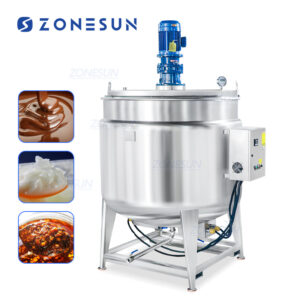
In real industrial applications, manufacturers select different configurations based on production capacity and process requirements. For example, in food and cosmetic production lines, systems similar to the ZS-MB2000LH Double-Layer Stainless Steel Mixing Tank With Heater are commonly used as core processing equipment.
Such systems typically offer:
- Flexible processing of materials ranging from low-viscosity liquids to high-viscosity pastes
- Customizable capacity from 50L to 5000Lfor different production scales
- Adjustable agitation structures to match different mixing requirements
- Corrosion-resistant stainless steel construction suitable for high-temperature environments
- Forklift support design for easy movement and installation within factories
This flexibility enables heated mixing tanks to handle a wide range of industrial processes, from small-scale pilot production to full-scale manufacturing.
Application Fields and Industrial Use Cases
Heated mixing tanks are widely used in industries that require controlled heating and uniform mixing.
In the food industry, they are widely used for applications such as chocolate melting, jam production, syrup processing, and milk handling. For instance, when making jams, the temperature is normally regulated to be between 80°C and 95°C in order to dissolve the pectin without causing sugar crystallization. In chocolate processing, temperature is typically controlled within a range of 45°C to 60°C.
Heating is common in the mixing of tanks for production of adhesives, paints, resins, and detergents. High viscosity is typical in such materials; therefore, heating and continuous mixing are required. For example, in paint manufacture, the process should run between 60°C and 120°C for effective dispersion of pigments.
In the pharmaceutical and cosmetic industries, they are commonly applied in liquid-phase dissolution, ointment formulation, and emulsion production processes. This requires a high level of hygiene, which is achieved through the use of closed systems and CIP (clean-in-place) cleaning systems.
Conclusion
Overall, a heated mixing tank plays an essential role in modern industrial production. By integrating heating and mixing functions, it significantly improves production efficiency, process stability, and product consistency.
With the development of automation and smart manufacturing, heated mixing tanks are evolving toward higher precision control and system integration, becoming a core piece of equipment in modern production systems.
In this field, ZONESUN PACKAGING is a professional industrial equipment manufacturer and solution provider. We offer reliable production equipment and technical support to global customers. If you have any questions about ZONESUN equipment selection, process optimization, or application solutions, feel free to contact ZONESUN PACKAGING for professional assistance.