English
  Russian
  Korean
  Indonesian
  Spanish
  Thai
Thai 

For industries such as vaccines, biotechnology products, and cosmetics, the vial filling and capping machine is an essential machine in the production line. The machine automatically fills and caps the liquid, solution, or powder in the vial.
With a vial filling and capping machine, there will be less human intervention, no contamination, and precise volume filling per vial.
Common Types of Vial Filling and Capping Machines
Manual and Semi-Automatic Vial Filling and Capping Machines
The manual and semi-automatic types of vial filling and capping equipment can be used for small-scale manufacture, in laboratories, and for pilot batches. The strengths of these types of machines are easy design, inexpensive initial capital, and flexible operation.
However, these types of vial filling and capping equipment depend greatly on the operator, hence cannot be used in high-speed production. These machines cannot be used for mass production due to low speed, but they can be effectively utilized in research, development, and small batch production.
Automatic Vial Filling and Capping Machines
Automatic vial filling and capping machines are specifically designed for large-scale manufacturing processes.
The key benefits of fully automatic machines:
- High throughput and precision, reducing human error
- Lower contamination risks
- Lower operating costs
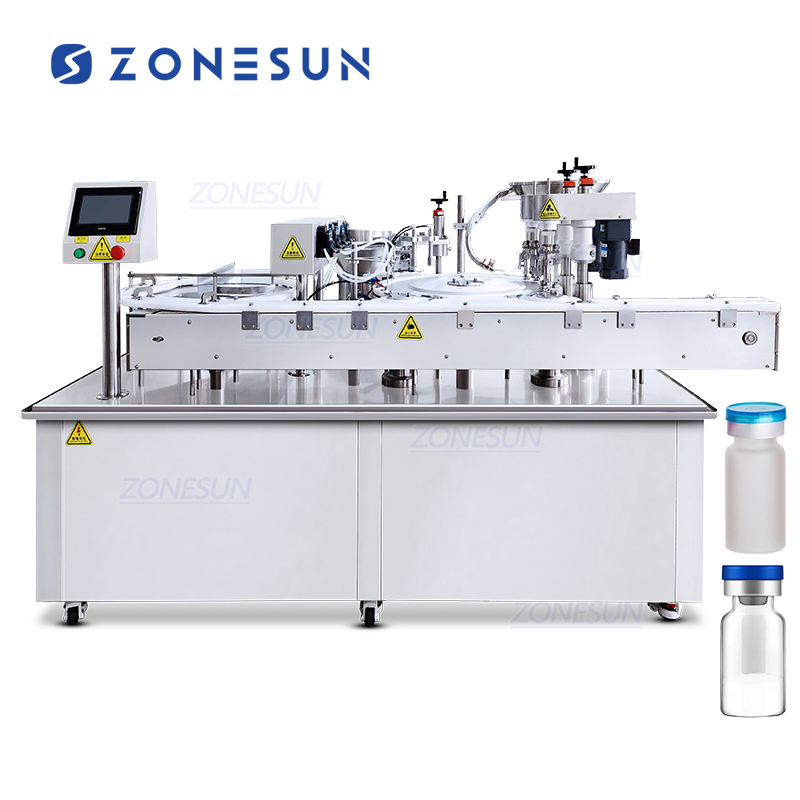
For instance, ZONESUN’s Rotary Automatic Liquid Vial Filling & Capping Machine is one of the most efficient machines when it comes to industrial manufacturing. The machine has several features, such as cam control, high production capacity of up to 4000 bottles per hour, multi-functional capabilities such as sorting, filling, cap supplying, and crimping, and a peristaltic filling mechanism with variable filling volumes. The machine is ideal for use in the manufacture of pharmaceuticals, vaccines, and biotech products.
Sterile Vial Filling and Capping Machines
These types of machines have special designs to handle vaccines that make it ideal for handling vaccines and other biological drugs. In most cases, the machines are designed with controlled aseptic work zones, including HEPA filters.
The sterile vial filling and capping machines are entirely automated and are equipped with real-time monitoring and data logging systems that conform to GMP/FDA standards.
Choosing a Vial Filling and Capping Machine by Its Filling Method
The filling method plays a major role when choosing a vial filling and capping machine. Various liquids and products demand various methods of filling:
- Peristaltic Pump System: Offers high precision, suitable for high-viscosity liquids or products with strict dosage requirements.
- Piston or Syringe System: Best for small-volume or highly precise filling, providing excellent repeatability.
- Vacuum Filling: Reduces air contact, suitable for sterile or sensitive liquids.
- Choosing the right filling method ensures that your vial filling and capping machine meets both efficiency and quality standards.
Which Vial Filling and Capping Machine Is Right for Your Business?
Different types of vial filling and capping machines come with different outputs, precision, contamination control, and costs:
Feature | Manual/Semi-Automatic | Fully Automatic | Sterile/Aseptic |
Production Capacity | Low | High | Medium–High |
Labor Requirement | High | Low | Medium |
| Filling Accuracy | Moderate | High | Very High |
Contamination Risk | Higher | Low | Minimal |
| Investment Cost | Low | High | High |
| Automation Level | Basic | High | High |
| Ideal Application | Small-scale / R&D | Large-scale Production | Vaccines / Injections / Biological agents |
While choosing a vial filling and capping machine, businesses should take into consideration the following factors:
- Production capacity- A semi-automatic machine for small capacity, while a fully automatic machine for high-capacity production.
- Product Type- High-value/sterile products will need an aseptic machine.
- Economic viability- A fully automated machine saves on manpower and wastage.
- Ease of operation – Automated and smart machines simplify operation and support multiple shifts.
Conclusion
Selection of the appropriate machine for vial filling and capping can greatly contribute to achieving an effective optimization of production lines, improving efficiency, guaranteeing the quality of products, and reducing expenses. Manual and semi-automatic machine types are suitable for small-scale manufacturing industries or laboratories, whereas fully automatic or sterilized machines are best for large pharmaceutical factories.
Selecting ZONESUN is an indication that you have chosen to go for the best automation devices, which will increase production efficiency and lower production costs.