English
 Russian
 Korean
 Indonesian
 Spanish
 Thai


Proper labeling of goods on automated packaging production lines is extremely important, as it will define the visual attractiveness of the brand as well as its compliance and traceability. Whatever you manufacture, whether it is food, beverages, pharmaceuticals, cosmetics, or chemicals, correct label placement guarantees the best visual effect without any loss of legibility of batch codes, barcodes, and anti-fraud labels. The following article will give you information about sticker labeling machines, including their technical specifications, fields of application, implementation methods, and operation principles.
1. What is a Sticker Labeling Machine?
The sticker labeling machine is a packaging machine that is automated and semi-automated and can peel and apply self-adhesive labels to bottles, containers, boxes, and pouches with the aid of a mechanical, electrical, and optical control system.
The basic elements of the sticker labeling machine include:
- Unwinding and Tension System: Ensures smooth feed of the label web while maintaining consistent tension.
- Dispensing Plate (Peeler Blade): Detaches the stiffer label material from the more flexible backing liner by bending it sharply at an angle of approximately 15°–30°.
- Optical Sensing System: The optical sensing system is composed of both object and label sensors, which detect edges of containers and gaps between labels, hence providing repeatable positioning accuracy within ±0.5 mm to ±1 mm.
- Wiping and Pressing Device: This machine makes use of sponge rollers, brush wheels, or pneumatic pads to eliminate air bubbles.
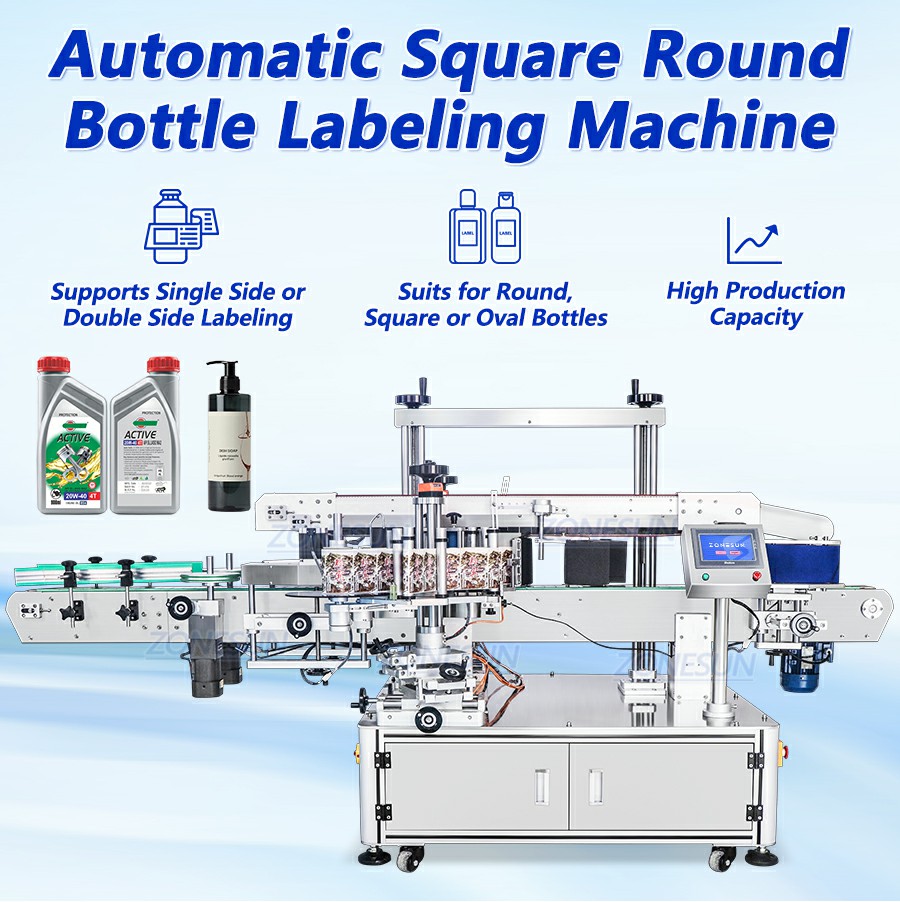
Machine settings vary depending on container shape and production line requirements. For liquid products, versatile systems such as the ZONESUN ZS-TB963 Automatic Liquid Soap & Juice Bottle Labeling Machine can handle both round and flat containers using a variable-speed conveyor belt for single- or double-side labeling.
2. How Does the Sticker Labeling Machine Work?
The process flow of a sticker labeling machine is based on the real-time collaboration between the optical detection, the servo motor drive, and the mechanical alignment. This process takes a fraction of a millisecond in four distinct steps:
Container Feeding & Spacing
The unlabeled products will be conveyed through the conveyor belt towards the station. A star wheel or spacing screw separates incoming containers at regular intervals, typically 100–150 mm apart.
Sensing the Signal and Triggering
When the leading edge of the container reaches the photoelectric object sensor, the signal is sent to the controller. The time for the product’s dispensing delay (from 10-50 ms) is determined by the speed of the line.
Dispensing at an Angle and Speed Synchronization
The PLC control drives the stepper or servomotor traction motor to pull the liner paper. When the liner paper turns over a 15°-30° angle on the Dispensing Plate, due to its stiffness, the label detaches from the liner and extends to the front. At this stage, the dispensing speed should correspond to the line speed within ± 1%.
Roller Cleaning and Removing Air Bubbles
As soon as the leading edge of the label touches the container, secondary brush wheels or sponge rollers roll over it. Applying a pressure of 0.2-0.4 MPa, air bubbles are removed from the surface.
3. What is a Sticker Labeling Machine Used For?
Automated labeling equipment is essential in manufacturing industries where packaging accuracy and batch tracking are strict requirements:
| Industry Sector | Common Container Types | Key Technical Specifications |
| Food & Beverage | Sauce bottles, juice containers, seasoning jars | 60–150 bpm line speed, moisture-resistant labels, zero bubbles |
| Pharmaceuticals | Vials, syrup bottles, and medicine cartons | ±0.5 mm labeling accuracy, with integrated batch number and expiration date coding |
| Personal Care | Hand soap bottles, shampoo containers, laundry detergent bottles | Accurate double-sided positioning, anti-flagging edge control |
| Logistics & Warehousing | Shipping cartons, outer cardboard boxes | Four-corner tamper-evident labeling, real-time QR code printing |
In high-speed production settings requiring continuous throughput, machine stability is critical. High-volume environments benefit from specialized equipment such as the ZONESUN ZS-TB920 Sticker Labeling Machine For Round Bottles, which uses the multi-station rotary carousel to balance cylindrical packages at speeds of up to 6,000 to 8,000 bottles per hour—a good fit for a sticker labeling machine in large-scale beverage or pharmaceutical production.

4. Full Line Interface and Integration
In the present smart factory era, individual machines are often employed as part of an automatic system. The sticker labeling machine serves as an important linking device between the upstream filling/capping process and downstream cartoning/packaging operations.
Flow from Upstream to Downstream
Upstream Filling/Capping Process → Sticker Labeling Machine → MES/ERP Data Synchronization
Interlocking Signal
Industrial standards such as Ethernet/IP, Profinet, and RS-485 are employed by the machine to provide interlocks for signal synchronization, label skipping, and upstream stoppage during a jammed situation.
Integration of Data Tracing & Tamper Resistance
TIJ printers, hot-stampers, and cameras can be attached to the labeling head. For high-security outer package seal, specialized machinery such as the ZONESUN ZS-TB833F Labeling Machine utilizes specialized corner-folding press units to secure label edges firmly around carton corners while integrating seamlessly with line data systems.

5. How to Operate a Sticker Labeling Machine?
Proper compliance with the procedure of work contributes to correct adjustment and extends the service life of machine components:
- Initial Check: Make sure that the input power supply (AC 220V/50Hz or 110V/60Hz) is available and ensure that pneumatic air pressure has a reading of 0.4 to 0.6 MPa. Remove dust from the lenses of optical sensors.
- Web Threading & Tensioning: Perform threading of the label roll according to the diagram of threading through tension arms, guide rollers, and peeler plates. Adjust the drive roller and tension of the web.
- HMI Parameter Settings: On the screen interface, choose the saved profile for the product. Define the dispensing delay, label length, and belt speed.
- Calibration of Sensors: Calibrate the label gap sensor in order to ensure its correct identification of label stock and transparent gap on liner paper.
- Testing and Calibration: Conduct three to five tests using sample containers to test labeling accuracy. Adjust the peeler blade angles and pressure of the press roller in case of skewed or wrinkled labels.
6. Conclusion
A sticker labeling machine can automatically apply labels to different products. It can be used for labeling bottles, boxes, pouches, or other products. Compared with manual labeling, the automatic sticker labeling machine ensures accurate placement, efficient production, and uniformity in labeling. There are many ways of configuring the machine depending on the type of product, the shape of the container, the speed at which the labels should be applied, among others.
When selecting a machine, take into consideration the labeling speed, the accuracy of placement, and the kind of products used. ZONESUN manufactures different types of labeling machines for various applications. Come and contact us if you are looking to upgrade your current labeling operations.