English
  Russian
  Korean
  Indonesian
  Spanish
  Thai
Thai 

For food, pharmaceutical or chemical industries, an essential part to seal the containers is cap liner. It is the piece of material that sits inside the cap of a bottle or jar and makes sure products stay fresh and tamper evident.
Cap liners used to go in by hand. Fine for small batches. But as output grows, the cracks show. Labor costs climb. Insertion quality starts to depend on who’s doing the work that day. Keeping up a steady production speed gets harder and harder.
This is the gap an automatic cap lining machine fills. Rather than relying on manual handling, it takes over the whole sequence—feeding caps into position, separating liners one at a time, inserting each into place, then discharging finished caps toward the next stage of production. Fewer interruptions, more output. The manufacturing process, in other words, becomes something closer to a continuous line rather than a series of manual handoff.
What is An Automatic Cap Lining Machine?
An automatic cap lining machine is specialized equipment designed to insert sealing liners into plastic or metal caps. Depending on the cap design and liner material, the machine may work with induction sealing liners, pressure-sensitive liners, EPE foam liners, vented liners, or other sealing materials.
During operation, caps and liners are supplied separately. The machine automatically orients the caps, picks up individual liners, places them accurately inside each cap, and checks whether the insertion has been completed correctly (on certain models). Then the lined caps will be moved to downstream equipment for collecting or sealing.
Today, cap lining machines are commonly used for food and beverage, pharmaceuticals, cosmetics, chemicals, lubricants, and household products.
Technical Features That Drive the System
Modern lining machinery relies on a mix of mechanical synchronization and smart sensors. Rather than just pushing material into a plastic shell, these units integrate several distinct systems:
- Integrated Cap Sorting: A rotary or vibratory bowl hopper automatically aligns scrambled caps, feeding them face-up into the main conveyor track.
- Precision Web Tensioning: For machines that cut liners directly from a roll, advanced tension controls ensure the material feeds without stretching or tearing.
- Dual-Option Feeding: Systems can be configured to either punch disks out of a continuous roll of liner material (saving material costs) orfeed pre-cut wads from a magazine.
- Smart Rejection Logic: Built-in photoelectric sensors inspect every single closure. If a cap lacks a liner or receives a deformed one, it is automatically purged from the line without halting the system.
The Workflow of Automatic Cap Lining Machines
How does a bulk box of plastic caps turn into a perfectly lined sealing component? The process is a continuous, synchronized loop.
- Feeding and Orientation
Caps are dumped into a large hopper. The machine sorts them so they all face the same direction, tracking down a chute toward the indexing wheel.
- Material Prep and Cutting
The liner material (often a multi-layered foil or foam) unrolls from a spool. As the cap moves into position underneath the die, a mechanical punch stamps out a perfectly round liner disk matching the internal diameter of the cap.
- Insertion and Bonding
The punched liner is pressed firmly into the bottom of the cap. Depending on the cap design, this might involve a simple friction fit, utilizing the cap’s internal threads, or a dot of hot-melt glue applied just before insertion.
- Inspection and Discharge
Before leaving the machine, sensors check the assembly. Perfectly lined caps head downstream to the bottling line; any anomalies are blown into a reject bin.
Advantage of Using Automatic Cap Lining Machines
Investing in dedicated lining automation alters production economics in a few distinct ways:
Drastic Waste Reduction: By stamping liners directly from a roll, these systems maximize material yield. You get more liners out of every square meter of material compared to buying pre-cut stock.
Labor Reallocation: Using automatic cap lining machines can automate the tedious, repetitive tasks. This enables your floor operators to focus on quality control or machine maintenance.
Enhanced Hygiene: As the liner material goes from the roll to the cap interior without human hands touching it, the risk of biological contamination is virtually zero—a massive requirement for food and pharmaceuticals.
Consistent Seal Integrity: Mechanical insertion ensures every liner sits perfectly flat. This prevents the skewed seals that cause slow leaks during product shipping.
Different Types of ZONESUN Automatic Cap Lining Machines
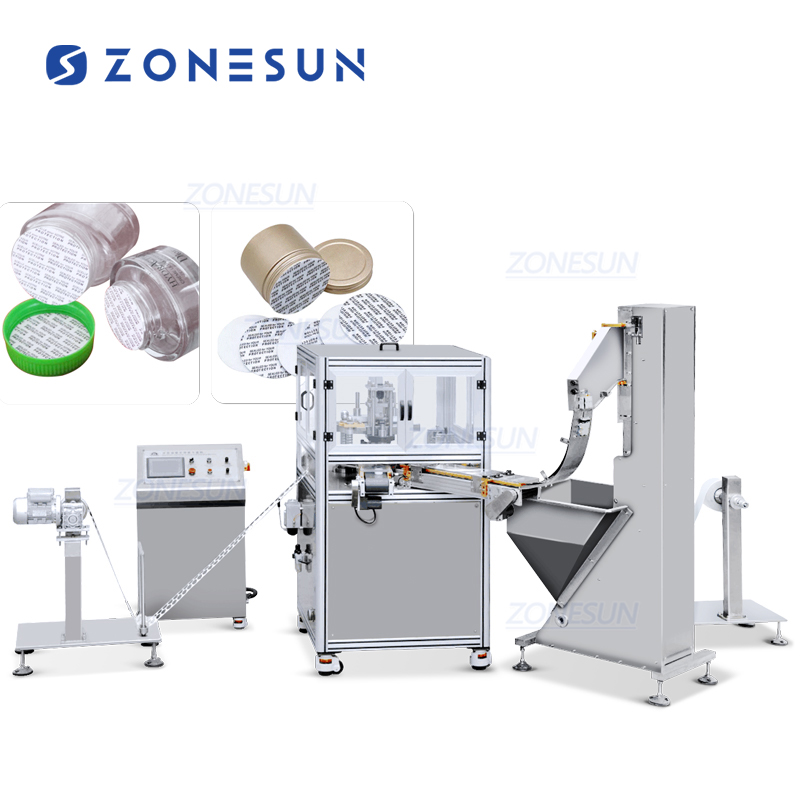
ZS-WIM01 Rotary Automatic Induction Seal Liner Inserting Machine – This model is designed for inserting seal liners into caps. It uses a rotary plate to position and convey caps during production, ensuring accurate inserting. The output of machine can reach 3000pcs per hour.

ZS-WIM02 Automatic Cap Liner Insertion Machine – This machine features functions of cutting and inserting liners from a roll. Its speed is 50-120pcs/min. The machine can be customized to suit for various cap and liner sizes. It can also work with capping machine and sealing machine to complete automated production.
What To Consider When Choosing the Right Automatic Cap Lining Machine
- Production capacity required per hour.
- Cap diameter and cap height range.
- Type and thickness of liner material.
- Required positioning accuracy.
- Compatibility with your existing production line.
- Ease of operation and maintenance.
- Availability of technical support and spare parts.
- Future production expansion plans.
Conclusion
Proper liner insertion contributes to preventing moisture, avoiding leakage and protecting products.
An automatic cap lining machine automates this critical manufacturing step by combining cap feeding, liner insertion, inspection, and discharge into one continuous process. For manufacturers seeking higher production volumes, reduced manual handling, and improved process stability, it has become an increasingly common part of modern cap production lines. If you are looking for a suitable cap lining machine which can match with your business, come and contact ZONESUN PACKAGING. We are an experienced packaging machine supplier and can provide tailed-made packaging solutions.
-768x645.webp)