English
  Russian
  Korean
  Indonesian
  Spanish
  Thai
Thai 

Jam manufacturing process is one part of the whole production. When jam manufacturing is finished, manufactures need to pack jams into containers. Handling these tasks manually might still be manageable for the small workshops. However, once the order quantity increases, manual packaging will not match the required volume. This is where an industrial jam bottling line can make a real difference.
A modern jam bottling line can automate much of the packaging process, helping food manufacturers fill containers more consistently and move products through the line with less manual work. Depending on the setup, the line can include jam filling, cap placement, capping, sealing, labeling, date coding, inspection, and even carton packing.
Of course, buying a complete packaging line is a major decision. The equipment with the fastest rated speed on paper might not be the best fit for your factory. Jam is thick and viscous, and may contain fruit chunks, so the filling equipment must be compatible with these product characteristics. When choosing the jam bottling lines, manufacturers need to consider the factors including container size, production volume, available space, and future expansion.This guide takes a practical look at jam bottling equipment and the things food processing businesses should think about before investing in a new line.
What Is a Jam Bottling Line?
A jam bottling line is consisting of a group of machines, which work together to package jam into jars, bottles, or other containers. These different machines can handle the filling, capping and labeling works automatically as the containers move along the conveyor. A basic line might consist of a filling machine, capping machine, and labeling machine. A larger installation can go much further, with container cleaning, inspection, case packing, and palletizing.
The actual setup depends on the product and the factory.
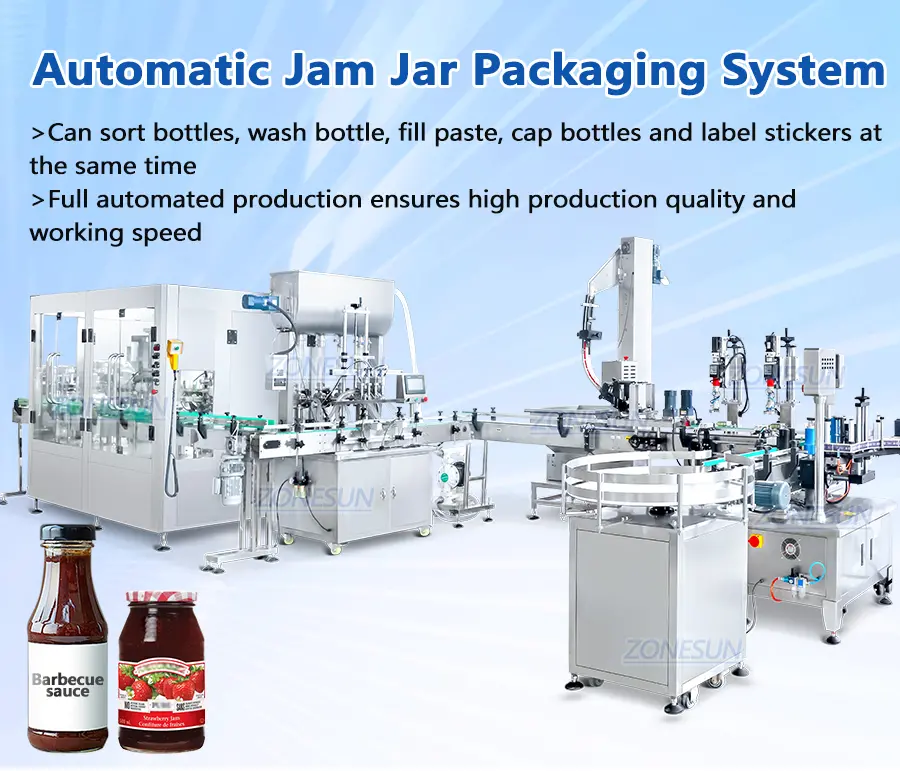
For example, ZS-FALU3 Fully Automatic Strawberry Jam Pasta Sauce Bottle Filling Line from ZONESUN PACKAGING is one kind of jam bottling line. It performs bottle washing, filling, capping, labeling, and sorting. The model is an ideal choice for packing pastes into glass jars.
Why Are More Jam Producers Moving Toward Automation?
There is a simple reason: manual packaging becomes harder to manage as production grows. It is hard for the workers to fill the containers one by one while maintaining the same fill level in each containers. There may also be small spills, inconsistent cap tightening, labels that are slightly out of position, and interruptions when workers need to move containers from one process to another.
None of these problems may seem serious on their own. Across thousands of jars, however, they can add up. Automatic jam bottling line helps bring more consistency to the process.
More Consistent Filling
Filling accuracy is important for jam because the product itself has value. If every jar receives slightly more jam than required, the manufacturer is effectively giving away product. On the other hand, under-filling can create quality and compliance issues.
An automatic filling machine uses controlled dosing to put a predetermined amount of jam into each container. The exact filling method depends on the jam’s viscosity and whether it contains fruit pieces or other particulates.
The result is a more consistent product from one jar to the next.
Higher Output
A production line also allows a company to increase its output without adding workers to every stage of the packaging process. The jam bottling line can perform filling, cap placing, capping and labeling continuously, which reduces manual handling. Then the workers can concentrate on operation monitoring, material supply and quality inspection. This can enhance production quality.
For a growing food business, this can be an important step toward increasing production without making the packaging department significantly larger.
A Cleaner and Controlled Process
Food manufacturers have to pay attention to hygiene. Reducing unnecessary handling of open containers is one way automation can help create a more controlled packaging environment.
Modern jam bottling line can also be designed to make cleaning and routine maintenance easier. Product-contact parts can be made from appropriate food-grade materials, while the machine layout can provide access for inspection and sanitation.
Automation cannot replace standardized sanitation procedures. Cleaning schedules, sanitation standard operating procedures, operator training, and food safety control measures remain essential.
How Does a Jam Bottling Line Work?
Every installation is slightly different, but the packaging process generally follows a straightforward sequence.
· Containers Entering: Empty jars or bottles are placed onto the conveyor and moved toward the filling area. Depending on the production setup, containers may go through a cleaning or rinsing process first. .
· Jam Filling: The containers are positioned under the filling nozzles, and a measured amount of jam is dispensed into each one.
· Cap Placement: Once the containers have been filled, caps are supplied to the line. An automatic cap feeder can sort and orient the caps before sending them toward the containers. Then the guide rail or gripper can place caps onto jars or bottles.
· Container Capping or Sealing: The capping machine tightens the caps to the required level.Depending on the type of packaging and product, an additional sealing process may also be used.
· Label Applying: After sealing, the containerswillmove to the labeling section. Some labeling machine will uses laser coder or ribbon coder to print dates automatically.
· Finished Products Cartoning: Finished jams can be placed into cartons, trays, or casesat the end of the line.Secondary packaging can also be automated in high-volume production. Some factories go further and add robotic palletizer so that finished cases are automatically arranged onto pallets.
Choosing the Right Jam Bottling Line
Not all jam bottling lines are designed for the same products. This is one area where manufacturers should avoid choosing equipment based purely on a brochure specification.
Think About the Consistency of Jam
Is your jam smooth and relatively easy to pump? Is it very thick? Does it contain whole pieces of fruit? These questions matter.
A filling machine designed for low-viscosity liquids may not perform well with a dense fruit preserve. Products containing large pieces can create additional challenges for pumps and filling valves.
Before selecting a machine, provide the supplier with as much information about the product as possible. In many cases, testing with an actual product sample is the best way to determine whether a particular filling system is suitable.
Consider Container Sizes
Some companies use one standard jar size. Others offer a range of products. If your product has various ranges, the jam bottling line needs to accommodate those formats. It shouldn’t become an unnecessarily long process when switching between different formats. A well-designed system can make format changes relatively straightforward, reducing downtime between production runs.
Don’t Forget Future Growth
It’s tempting to buy jam bottling line based only on today’s production volume. But if sales are growing quickly, a line that is perfect for today’s output may be too small in a couple of years. That doesn’t necessarily mean you need to buy the largest possible machine. Over-sizing equipment can also increase the initial investment unnecessarily. The better approach is to look at your expected production over the next few years and choose a capacity that leaves some room for growth.
Why a Complete Jam Bottling Line Can Be Better Than Separate Machines
A factory can purchase individual machines and connect them together, but an integrated packaging line often makes the overall process easier to manage.
When the machines are designed to work together, the conveyor speed, filling cycle, capping operation, labeling, and other processes can be coordinated.
This matters because a production line is only as fast as its slowest major stage.
For example, there is little benefit in having a very fast filling machine if the labeling machine cannot keep up. Containers will simply accumulate between the two processes.
A balanced line is usually more useful than a collection of machines selected independently.
Integration can also make troubleshooting easier because the equipment supplier can take responsibility for the overall system rather than leaving the manufacturer to solve compatibility issues between different machines.
Final Thoughts
For food processing businesses, packaging can become a bottleneck long before the actual jam-making process reaches its limits.
An industrial jam bottling line can help solve that problem by bringing filling, capping, labeling, coding, and other packaging operations into a more efficient and controlled process.
If you’re planning to upgrade your jam packaging process, come and contact ZONESUN PACKAGING. ZONESUN PACKAGING can offer complete jam bottling lines to meet your production demands.